UK Bridal Shop Weight-Loss Waivers Explained
Key Takeaways
- Approximately 22% of UK bridal boutiques now use a weight-loss waiver or supplementary clause for GLP-1 brides in 2026
- The waiver is a commercial protection for the boutique, not a legal barrier for the bride — most are simply extra cost disclosures
- A well-drafted waiver tells the bride upfront what alteration costs will apply if she changes beyond 2 dress sizes
- Some boutiques are using the waiver process as a consultation trigger — a chance to have a proper conversation about timeline and design
- Brides who sign a waiver without reading it carefully risk unexpected charges of £200-£600 added to the final invoice
- The waiver should specify: cost per size-band of change, timeline requirements, and what the boutique will not cover
Why waivers emerged
The weight-loss waiver is a direct response to a commercial problem that bridal boutiques began encountering in volume from 2023 onward.
A bridal boutique’s business model is built around a specific sequence: the bride orders a dress, the boutique orders it from a manufacturer and takes a margin, the dress arrives and is altered to fit, and the bride collects it. The boutique’s seamstress time and material costs are priced into the original dress price or quoted separately as a fixed alteration fee.
This model works when alterations are standard — hemming, taking in side seams by 1-2 sizes, adjusting straps. It stops working when a bride’s body changes by 3-4 sizes between the ordering date and the final fitting. The labour cost of near-complete reconstruction (rebuilding the bodice, re-cutting the skirt, replacing the back closure) is not covered by a standard alteration fee of £80-£200. It costs £400-£700.
Until 2023, this situation arose only occasionally — a bride who became seriously ill, a bride who had a baby mid-engagement — and boutiques handled it case by case. From 2023 onward, the number of GLP-1 prescriptions in the UK grew rapidly, and the case became common enough to require a systematic response.
The weight-loss waiver is that response. It formalises the cost discussion that boutiques were previously having informally or not at all.
What a typical waiver says
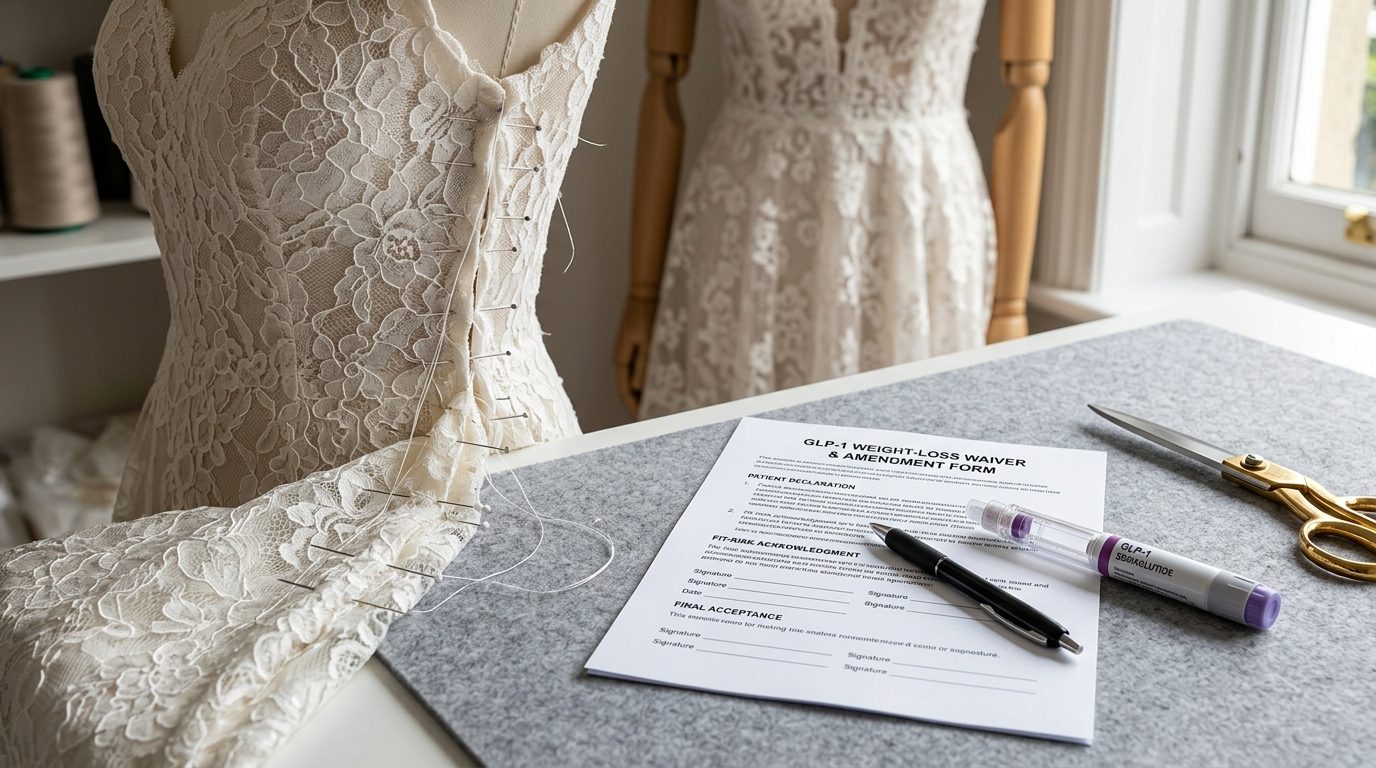
Standard alteration allowance. The waiver states what is included in the dress price: typically “alterations to accommodate up to one dress size of change.” This makes explicit what the original contract may have left implicit.
Additional cost schedule. The cost per size-band of change beyond the standard allowance. A typical schedule:
| Change | Additional alteration cost |
|---|---|
| 1 size beyond allowance | £80-£150 |
| 2 sizes beyond allowance | £180-£300 |
| 3 sizes beyond allowance | £280-£500 |
| 4+ sizes beyond allowance | £400-£700, or dress reconstruction quoted separately |
Measurement review point. The date by which the boutique needs a stable measurement to proceed with ordering. Often stated as “measurements must have been stable for a minimum of 4 weeks before the order is placed.”
Notification obligation. The bride confirms she will notify the boutique if her weight changes by more than a specified amount (typically 5kg) before the final fitting.
Exclusion clause. What the boutique will not cover: typically, situations where weight loss makes the dress fundamentally unreconstructable or where the construction cost would exceed the original dress price.
Red flags in poorly drafted waivers
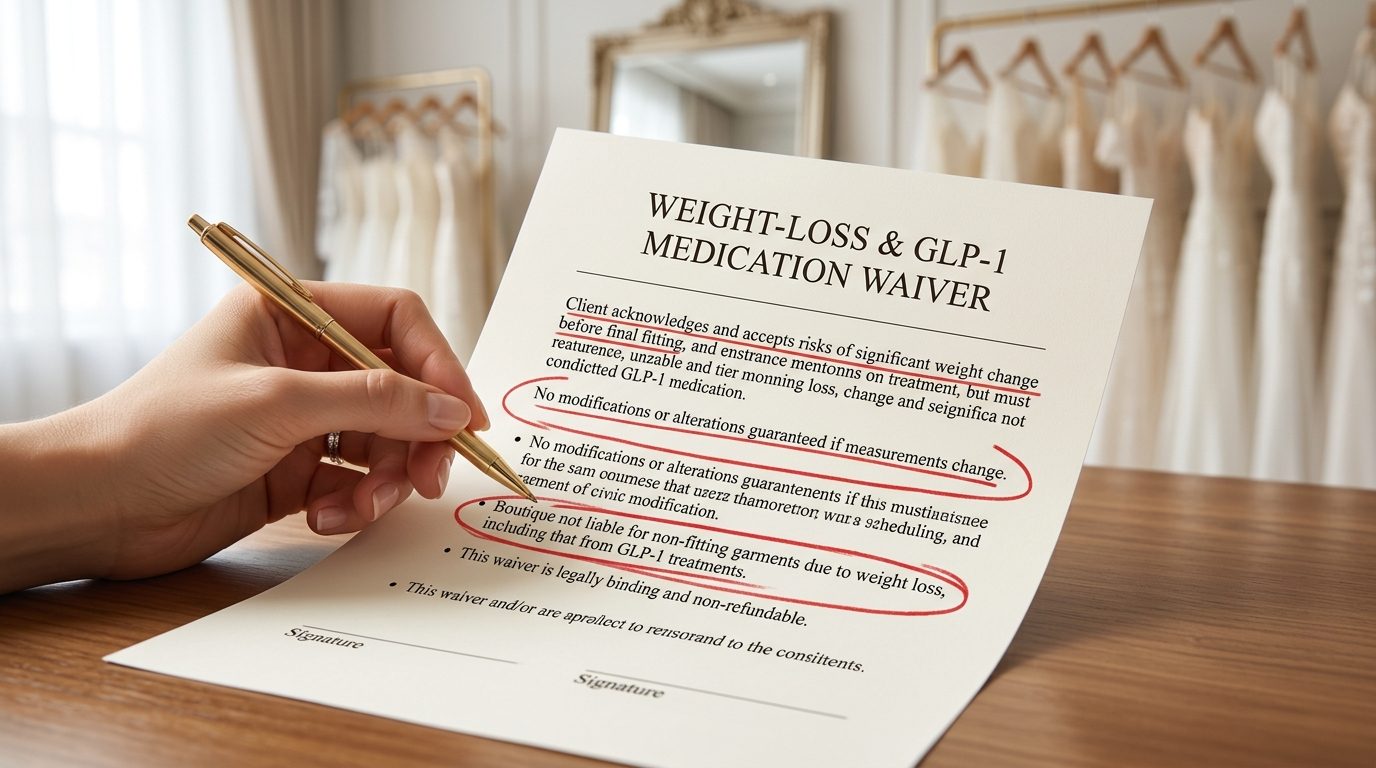
Open-ended “all costs” language. A waiver that states the bride agrees to pay “all additional costs arising from weight or body shape changes” without a cost schedule or cap gives the boutique unlimited discretion to charge for any work. This is commercially aggressive and is worth negotiating before signing.
No specification of what “significant change” means. A waiver that triggers additional charges for “significant weight loss” without defining “significant” creates ambiguity. Ask the boutique to specify a threshold — typically “more than one dress size as measured at the boutique’s standard measurements.”
Retroactive application. A boutique that presents a waiver after you have already paid a deposit is on weaker commercial ground. If you have already formed a contract and paid a deposit, a boutique cannot unilaterally add new conditions without your agreement. This is rare, but worth knowing.
No measurement review process. A waiver that puts all the obligation on the bride (to notify, to stabilise, to return for re-measurement) without committing the boutique to any process (when they will re-measure, what they will do with the new measurements) is one-sided. A fair waiver should include the boutique’s process, not only the bride’s obligations.
The conversation the waiver should trigger
The best boutiques use the waiver as a starting point for a proper consultation rather than as a document-signing formality.
A good consultation for a GLP-1 bride covers:
Timeline reassessment. Should the order be placed now or delayed? If weight is still in rapid decline, the right answer is often to wait. The boutique that prioritises a sale over a good fit outcome is not looking after the bride’s interests.
Design reassessment. Which designs accommodate the projected weight change most easily? The consultant should be able to explain the practical difference between a corseted back (adjustable without reconstruction) and a boned fitted bodice (requires reconstruction for significant changes).
Alteration planning. Who is the seamstress, what is her experience with significant reconstruction, and what does reconstruction actually involve? A bride who understands the process — and has confidence in the person doing it — is less likely to be surprised by the cost.
Contingency planning. What happens if weight loss continues beyond the final fitting? Most boutiques can do a second fitting at additional cost. Knowing this in advance is useful.
What you can negotiate
The waiver is a starting point, not a fixed document. The following are reasonable negotiating positions:
A capped maximum alteration cost. Ask for a maximum additional charge written into the waiver — for example, “additional alteration costs will not exceed £500 regardless of the extent of change.” This protects you from open-ended liability.
A delayed ordering date. Rather than signing a waiver for future uncertainty, ask whether the order can be placed closer to the wedding — 4-5 months out rather than 6-8 months — when your weight is more likely to be stable.
A re-measurement review point. Ask for the waiver to include a re-measurement appointment 3-4 months before the wedding, at which the ordering size can be confirmed or adjusted. This is the practical solution to the problem the waiver is trying to address.
A different alteration pricing structure. If the boutique’s alteration prices feel high, ask whether the work can be quoted separately by their seamstress rather than pre-priced in the waiver. Some boutiques have a fixed schedule; others will quote actual work on request.
Your consumer rights
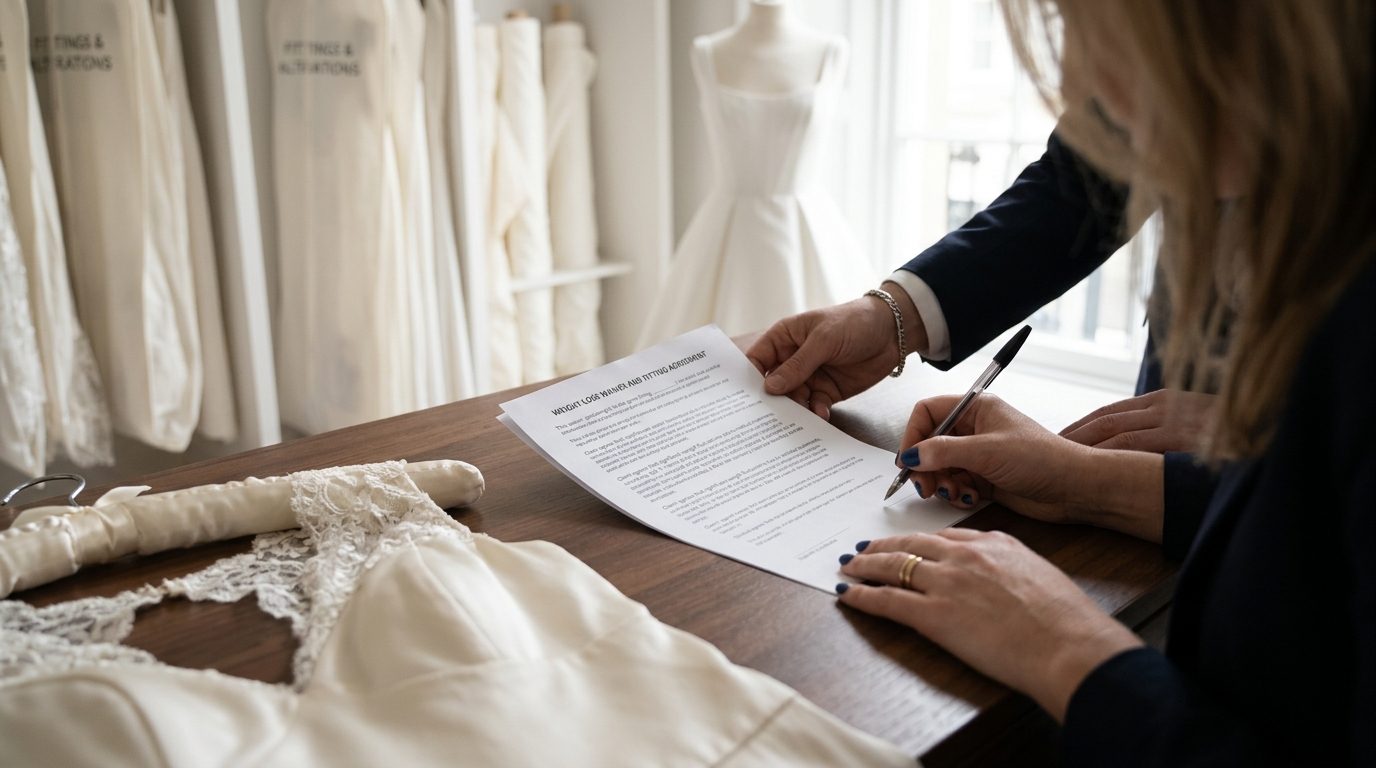
The waiver does not override your statutory consumer rights under the Consumer Rights Act 2015.
If a boutique has been informed that you are on GLP-1 medication and does not factor this into their ordering advice, and you suffer financial loss as a result of advice that was not in your interests (e.g., they told you to order at your current size despite knowing you would lose significant weight), you have grounds for a complaint under the Consumer Rights Act on the basis of a service not carried out with reasonable care and skill.
This is a high bar and is not a substitute for doing your own research and asking direct questions. But it means the waiver is not a complete liability shield for a boutique that provides poor advice.
For any dispute with a wedding supplier, see our wedding supplier deposit protection guide for the correct process under UK consumer law.
Boutiques getting it right
- Raised the topic proactively (rather than waiting for the bride to disclose)
- Had a written process with a cost schedule (not open-ended language)
- Offered a delayed ordering option or a re-measurement appointment
- Could explain the practical design implications (which styles accommodate change)
- Were transparent about their seamstress’s experience with reconstruction
The worst reviews came from boutiques that either had no process at all (leading to unexpected charges at the final fitting) or had an overly aggressive waiver with open-ended costs and no cap.
For a broader view of what to look out for when booking wedding suppliers, see our wedding venue red flags guide — many of the same principles apply to boutiques.
Related articles
Frequently asked questions
What is a bridal shop weight-loss waiver?
A weight-loss waiver is a supplementary document or clause in a bridal boutique's contract that sets out the alteration costs and terms that apply when a bride's measurements change significantly between ordering and the final fitting. Most are triggered by declared GLP-1 medication use. They typically specify: the standard alteration allowance included in the dress price, the cost per size-band of change beyond that allowance, and any deadline by which the boutique needs stable measurements to proceed.
Do I have to sign a weight-loss waiver at a bridal boutique?
No boutique can legally compel you to sign a supplementary document as a condition of a contract that has already been formed. In practice, most boutiques introduce the waiver at the point of ordering — it is a condition of accepting the order rather than a post-contract add-on. If a boutique presents a waiver you are uncomfortable with, you can negotiate the terms, ask for a different approach (such as a delayed ordering date), or choose a different boutique.
What should a weight-loss waiver include?
A fair and transparent waiver should specify: the standard alteration allowance included in the dress price (typically 1-2 sizes), the additional cost per size-band of change beyond that allowance (£80-£200 per extra size), a measurement review point (when the boutique will re-measure before ordering), any deadline for stable measurements, and the process if the change exceeds what the seamstress can alter. It should not include open-ended language about 'all costs arising from weight loss' without a cap.
Can a bridal boutique charge extra for alterations after I've paid a deposit?
Yes — if the alteration costs exceed the scope included in the original contract, or if the boutique's contract explicitly reserves the right to charge additional alteration costs. This is why reading the original contract carefully matters. A boutique whose standard contract says 'alterations included up to 1 dress size' can legitimately charge for work beyond that, with or without a separate waiver. The waiver simply makes explicit what the standard contract may already allow.
Should I tell a boutique about GLP-1 medication before signing a contract?
Yes — for your own protection. If you disclose medication use before signing and the boutique does not update their contract or waiver terms, and then claims extra costs later, you have a strong argument that the extra costs should have been included in the original quote. Non-disclosure does not legally protect you from alteration charges, but disclosure creates a record that the boutique was given the information and could have priced accordingly.
Are weight-loss waivers standard practice in UK bridal boutiques now?
Not yet standard, but growing. A further 31% have informal conversations about GLP-1 medication but no written documentation. The remaining 47% have no formal process — which can create disputes when significant weight change occurs unexpectedly. The trend is toward more formal documentation as the GLP-1 issue becomes more widespread.