Home / Articles / Wedding Trends
Brooches Replacing Boutonnieres: 2026 Style Guide
Key Takeaways
- Pinterest searches for 'wedding brooch lapel' increased 420% in the 12 months to April 2026
- Brooches are now chosen over traditional flower boutonnieres by approximately 1 in 8 UK grooms
- The trend is driven by sustainability concerns, cost, and the wider male jewellery shift in 2026
- Antique and vintage brooches from specialist UK dealers run £40-£400; contemporary designer pieces £80-£600
- The brooch works on the left lapel in the same position as a boutonniere — no alteration to the suit required
- UK jewellers and vintage markets are reporting a 60% increase in enquiries specifically for wedding brooches since 2024
Pinterest searches for “wedding brooch lapel” increased 420% in the 12 months to April 2026. Approximately 1 in 8 UK grooms now chooses a brooch over a traditional flower boutonniere. The shift is driven by sustainability concerns about cut flowers, cost considerations, and the broader trend towards male jewellery in contemporary wedding culture. UK vintage dealers and jewellers are reporting a 60% increase in wedding-specific brooch enquiries since 2024.
The boutonniere’s history — and why it’s changing
The flower boutonniere has been part of the groom’s dress code for over 150 years. Its origins lie in a Victorian tradition where the groom would cut a flower from the bride’s bouquet and wear it on his lapel. By the 20th century it had become a formality — a buttonhole for the groom and the male members of the wedding party, supplied by the wedding florist, worn for a few hours and then discarded.
The brooch boutonniere is not a new idea. In the 1940s and 1950s, brooches were commonly used when fresh flowers were not available, and many family heirlooms were worn for exactly this purpose. What is new in 2026 is the scale of the trend — the conscious, stylistic choice of a brooch over a flower, driven by aesthetic preference rather than necessity.
Three factors are converging.
Cost. A traditional boutonniere costs £8-£25 per buttonhole from a UK florist. For a wedding party of 6 men, that is £48-£150 spent on pieces that are worn for half a day. A single quality brooch, purchased second-hand, can cost the same or less — and it is kept.
Aesthetics. The male jewellery trend of 2025-2026 has made lapel accessories more visible and more intentional. A brooch reads as a considered choice in a way that a standard buttonhole does not.
The styles that work
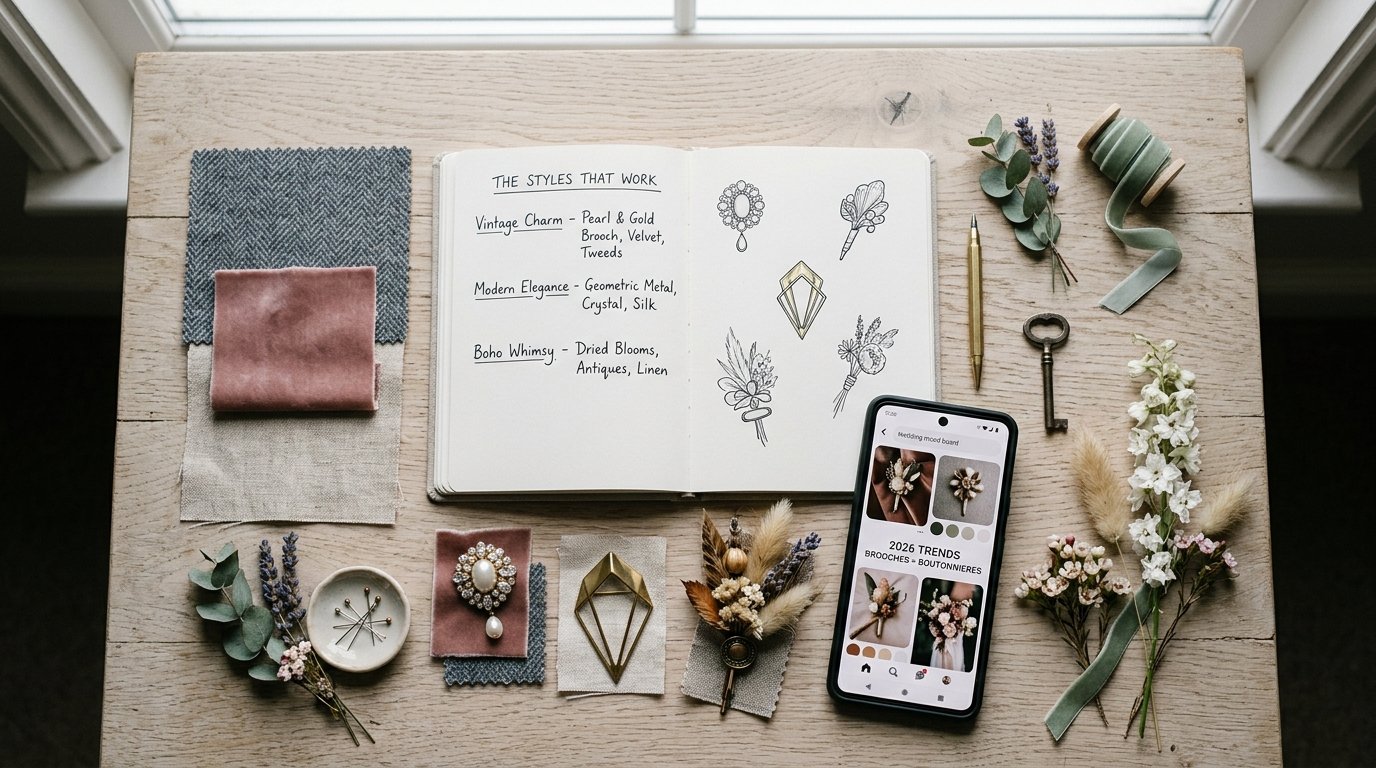
Not every brooch works on a suit lapel. The ones that do share a few characteristics: proportionate scale, clean lines, and a visual weight that reads as intentional rather than haphazard.
Floral motif brooches: A brooch with a flower or botanical motif is an explicit replacement for the boutonniere — it carries the visual language of the original while extending its lifespan indefinitely. Gold and silver floral brooches from Art Nouveau and Edwardian periods are currently sought after. Price range: £80-£400 depending on metalwork and period.
Contemporary designer brooches: UK and European jewellery designers are increasingly producing pieces designed specifically for lapel wear. Jenny Bird, Completedworks, and various independent Goldsmiths graduates are making pieces at the £80-£300 range. These tend to be more abstract or sculptural than vintage pieces — appropriate for contemporary or non-traditional weddings.
Tie pins and lapel bars: A related category — while not technically brooches, tie pins and lapel bars are a popular alternative. They secure the tie and add a refined detail without the visual weight of a brooch. Deakin & Francis (Birmingham), Drake’s, and Turnbull & Asser all stock quality options from £60-£250.
How to wear it
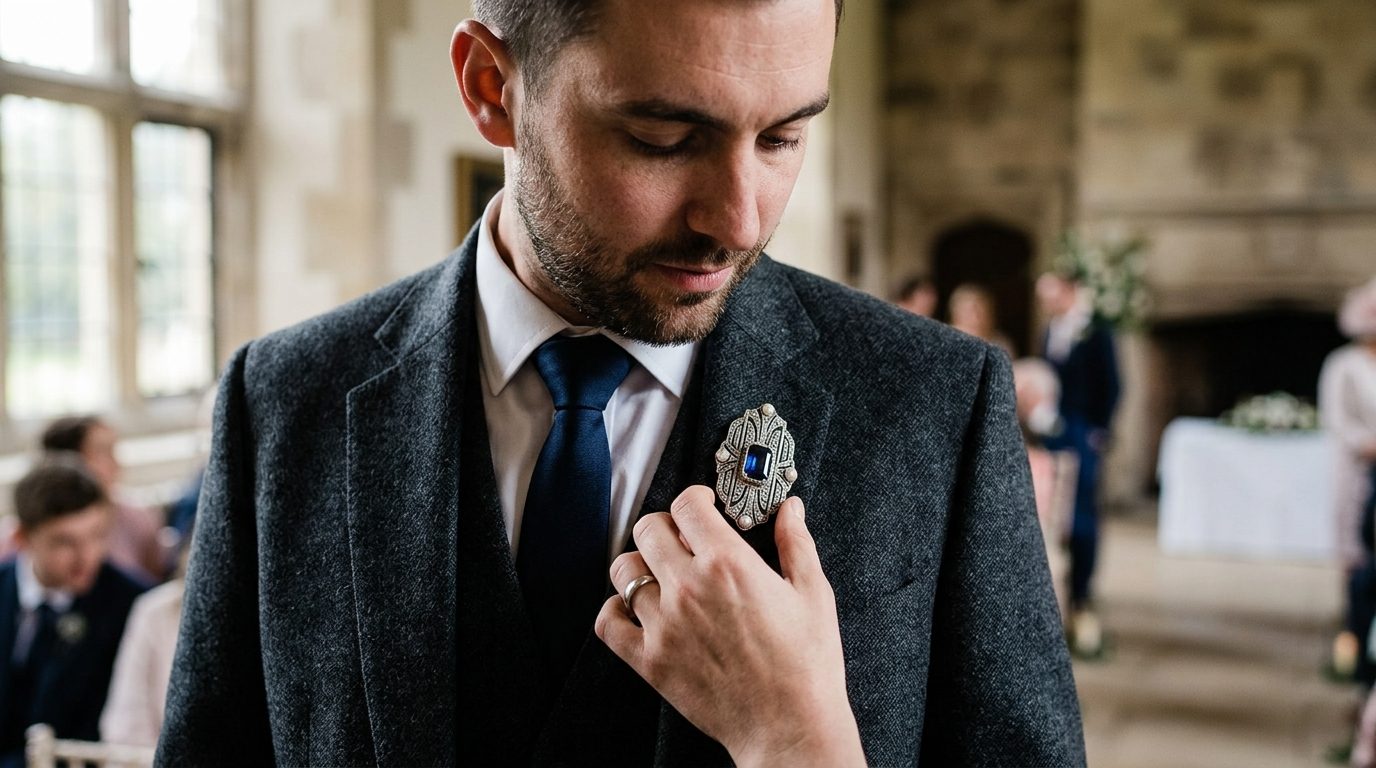
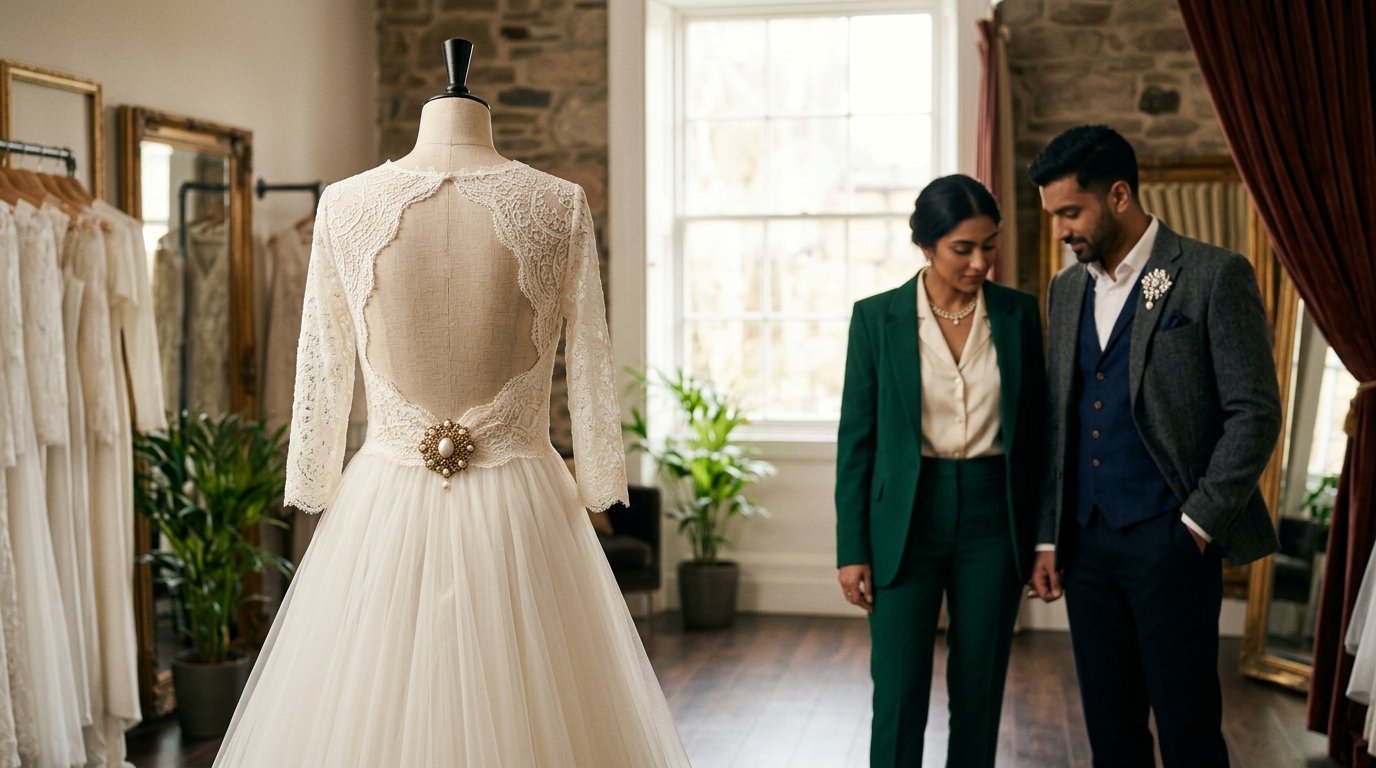
The brooch sits on the left lapel in the same position as a traditional boutonniere — approximately 10cm below the lapel notch, on the upper left of the jacket chest.
It is pinned through the lapel fabric, which requires no modification to the suit. Standard brooch pins grip most lapel weights without damage. If the pin is particularly heavy, a small padding piece behind the lapel fabric (widely available in haberdashery shops for £1-£2) prevents any pull on the fabric over a long day.
The brooch should sit above the pocket square, not alongside it. If you are wearing a pocket square, the brooch acts as the dominant detail — keep the pocket square simple. If you are not wearing a pocket square, the brooch becomes the sole accessory detail on the jacket, which gives it more visual room.
Scale guide: For a standard suit lapel (7-9cm wide), a brooch of 3-5cm diameter is ideal. Smaller reads as an earring pinned to a lapel. Larger overwhelms the lapel. For wide peak lapels, up to 6cm works well.
Colour guide: A single contrasting colour against the suit reads the most clearly. A dark suit with a navy or black brooch disappears. A mid-grey suit with a gold or enamel brooch in a warm tone registers well. A navy suit with a silver or white enamel piece is a clean combination.
Coordinating the wedding party
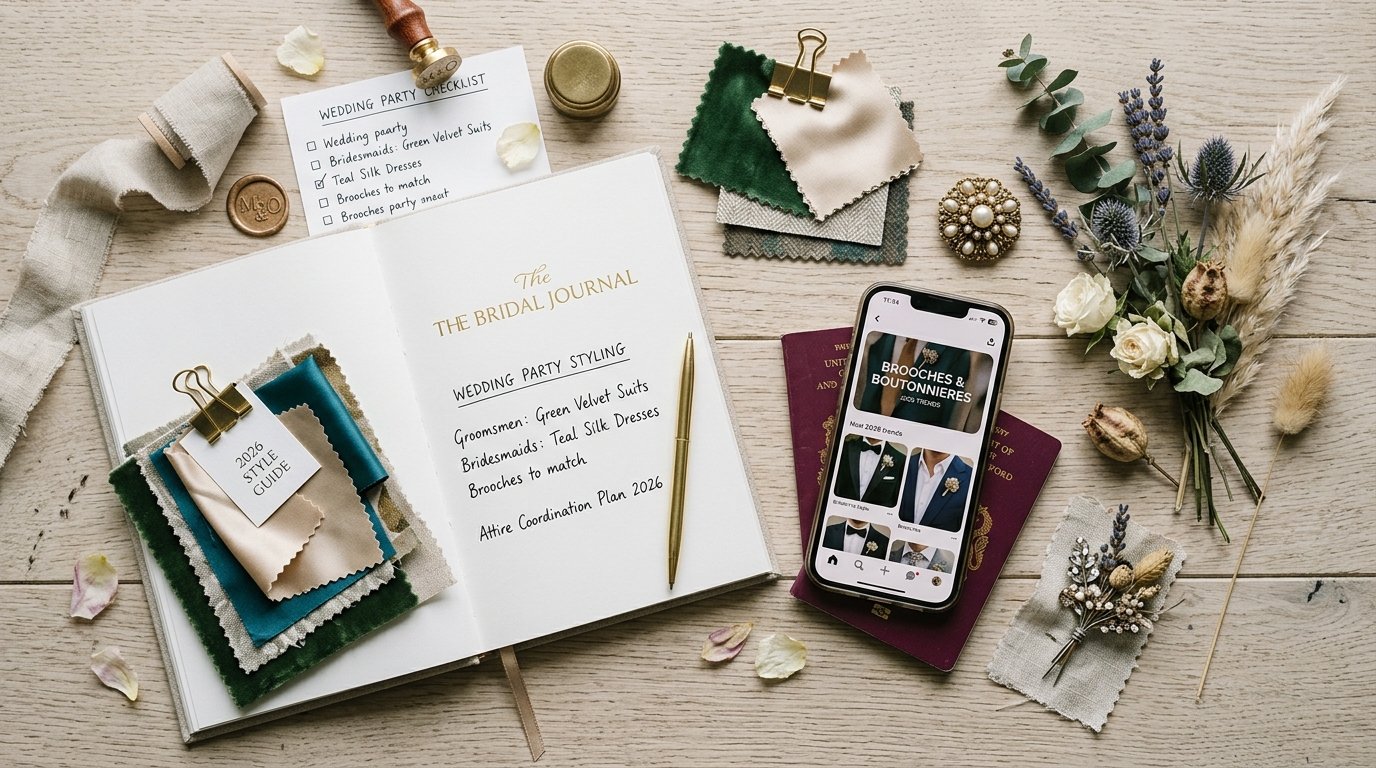
One of the strongest visual arguments for the brooch boutonniere is the ability to coordinate the entire wedding party with matching or complementary pieces.
A set of 6 matching vintage enamel brooches from a specialist dealer — all from the same period, same colour palette, slight variations in design — creates a cohesive look that is more interesting than 6 identical flower buttonholes. It is also often cheaper, and it means each groomsman takes home a piece they can wear again.
Two approaches to coordinating:
Matching design, varying colour: All groomsmen wear the same brooch silhouette in different colours from the wedding palette. Particularly effective with enamel pieces. Works at all price points.
Same period, varying design: All groomsmen wear Art Deco pieces, for example, but with different designs within that aesthetic. Looks curated rather than uniform. Best sourced from a dealer who can identify a cohesive group across their stock.
For the wider question of how to coordinate the male wedding party’s look, see our groom suit guide and our piece on men’s wedding jewellery.
Where to buy in the UK
Portobello Road Market (Notting Hill, London): Open Saturday mornings. Multiple dealers specialising in vintage jewellery, including brooches. Best browsed in person. Prices are negotiable.
Camden Passage (Islington, London): Antique market with a strong jewellery section. Wednesday and Saturday. More specialist dealers than Portobello for fine pieces.
Grays Antique Market (Mayfair, London): Indoor antique market with jewellery specialists who can advise on period and authenticity. Higher prices, higher confidence in provenance.
Scottish dealers: Edinburgh’s Grassmarket has several vintage jewellery sellers with strong Scottish antique brooch stock. Glasgow’s Barras market is another source.
Online: Etsy UK has thousands of vintage brooch listings. Filter by “Art Deco” or “Mid century” for consistent quality signals. Ruby Lane and 1stDibs have higher-value pieces with better provenance documentation.
Contemporary: Hatton Garden, Liberty London, and various independent jewellers for contemporary and designer brooches. The Goldsmiths Fair (autumn, London) is a good source for unique, newly made pieces.
Related articles
Frequently asked questions
Are brooches replacing boutonnieres at UK weddings?
Increasingly, yes. 1 in 8 UK grooms now chooses a brooch over a flower boutonniere, up from a much smaller fraction in 2022.
How do you wear a brooch as a wedding boutonniere?
Pin it on the left lapel, approximately 10cm below the lapel notch. The brooch should sit above the pocket square, not alongside it.
What types of brooches work best for a wedding boutonniere?
Vintage enamel pieces, floral motif brooches, Art Deco geometric designs, and family heirloom pieces are all appropriate. The scale should be proportionate to the lapel — typically 3-6cm diameter.
Where can I buy a wedding brooch in the UK?
Portobello Market, Camden Passage in Islington, Grays Antique Market, and specialist online dealers including Susie Cooper Ceramics and Ruby Lane are recommended sources.
How much does a brooch boutonniere cost compared to a flower boutonniere?
A quality brooch runs £40-£400 for vintage, £80-£600 for contemporary designer. A traditional flower boutonniere typically costs £8-£25 per buttonhole from a UK florist.
Can the wedding party all wear matching brooches?
Yes — a coordinated brooch for the entire wedding party is a popular 2026 styling choice. Matching or complementary pieces from a vintage dealer or a single designer create a cohesive look.