Home / Articles / Wedding Trends
Burgundy + Chartreuse: The Boldest 2026 Wedding Palette
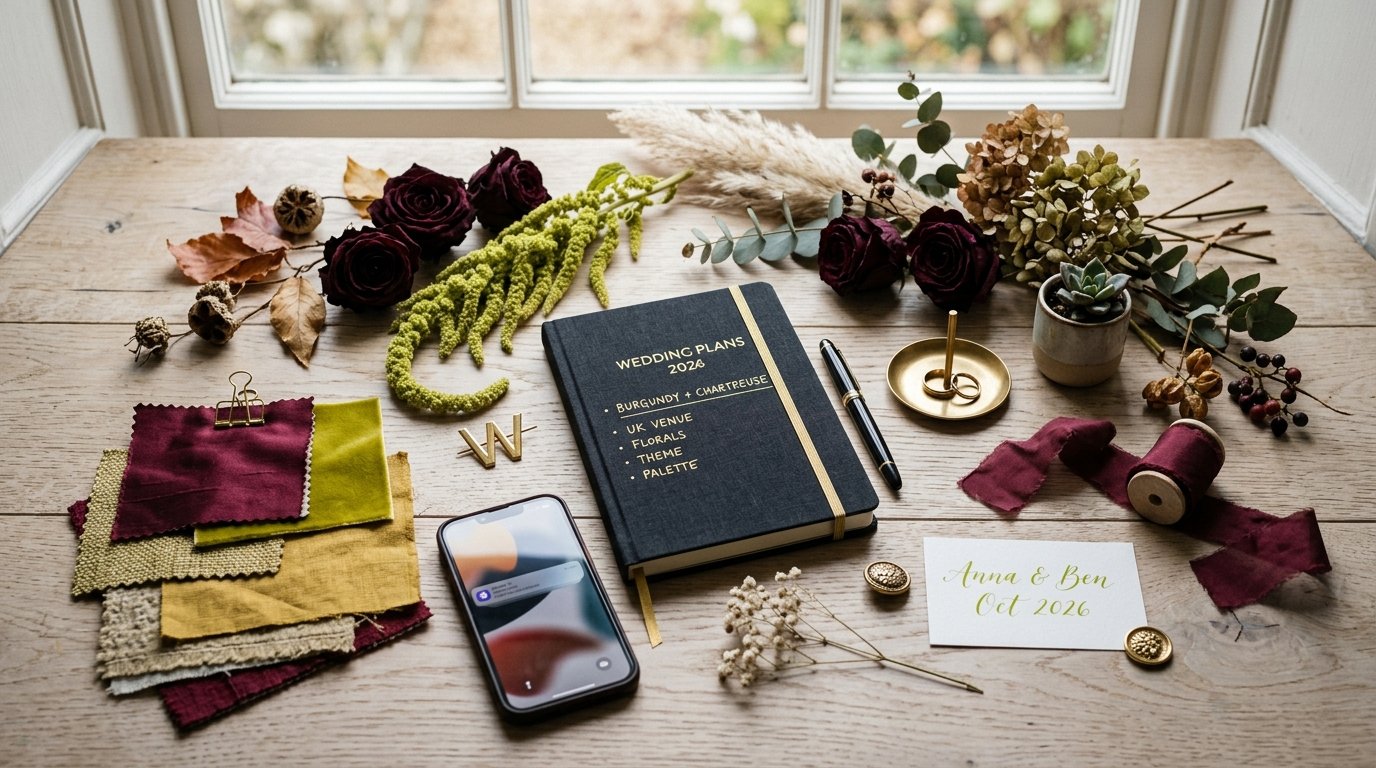
Key Takeaways
- Pinterest UK searches for 'chartreuse wedding' increased 380% in the 12 months to April 2026
- Burgundy and chartreuse are near-complementary on the colour wheel — high contrast, high impact
- 18% of UK brides surveyed by Weddings Hub in Q1 2026 wanted a bold, unconventional colour scheme
- The pairing works best in autumn and winter — October through February UK weddings
- Chartreuse bridesmaid dresses are currently 8-12 week lead time at most UK bridal boutiques
- Key flowers: deep burgundy dahlias, chartreuse chrysanthemums, green hypericum berries
Pinterest UK searches for “chartreuse wedding” increased 380% in the 12 months to April 2026, making this acid yellow-green the fastest-growing new accent colour in UK wedding search data. Paired with deep burgundy — its near-complementary colour on the wheel — chartreuse creates the highest-contrast wedding palette of 2026. Of the UK brides surveyed by Weddings Hub in Q1 2026 (n=310), 18% said they wanted a bold, unconventional colour scheme, with several respondents specifically naming chartreuse as a colour they planned to use. The pairing has dominated autumn wedding photography on Instagram and Pinterest since late 2025.
By Matt, Editor at Weddings Hub. Data from Pinterest UK trend reports (Q1 2026) and Weddings Hub 2026 UK bride survey (n=310, Q1 2026). Bridesmaid dress lead-time data from Weddings Hub supplier directory survey (n=45 UK bridal boutiques, April-May 2026).
Why this pairing works — and why it is risky
The colour wheel explanation is simple. Burgundy is a deep red-purple. Chartreuse is a yellow-green. They sit close to opposite each other on the wheel, meaning they create maximum contrast without clashing. Complementary pairs have been used in fine art and fashion for centuries because the eye finds them vivid and satisfying.
The risk is that the contrast tips into conflict rather than drama. This happens when:
- The chartreuse is too bright (closer to neon yellow-green than acid yellow-green)
- The two colours appear in exactly equal proportions, creating visual competition
- The venue’s own colours fight the palette (cream walls make chartreuse look sickly)
The solution to all three problems is the same: let burgundy lead. Use chartreuse as an accent and punctuation mark — in flowers, in ribbon ties, in one or two bridesmaid dresses — rather than as a co-equal partner. The palette works when it reads as “burgundy wedding with a sharp chartreuse edge” rather than “half burgundy, half lime green.”
The flowers of this palette
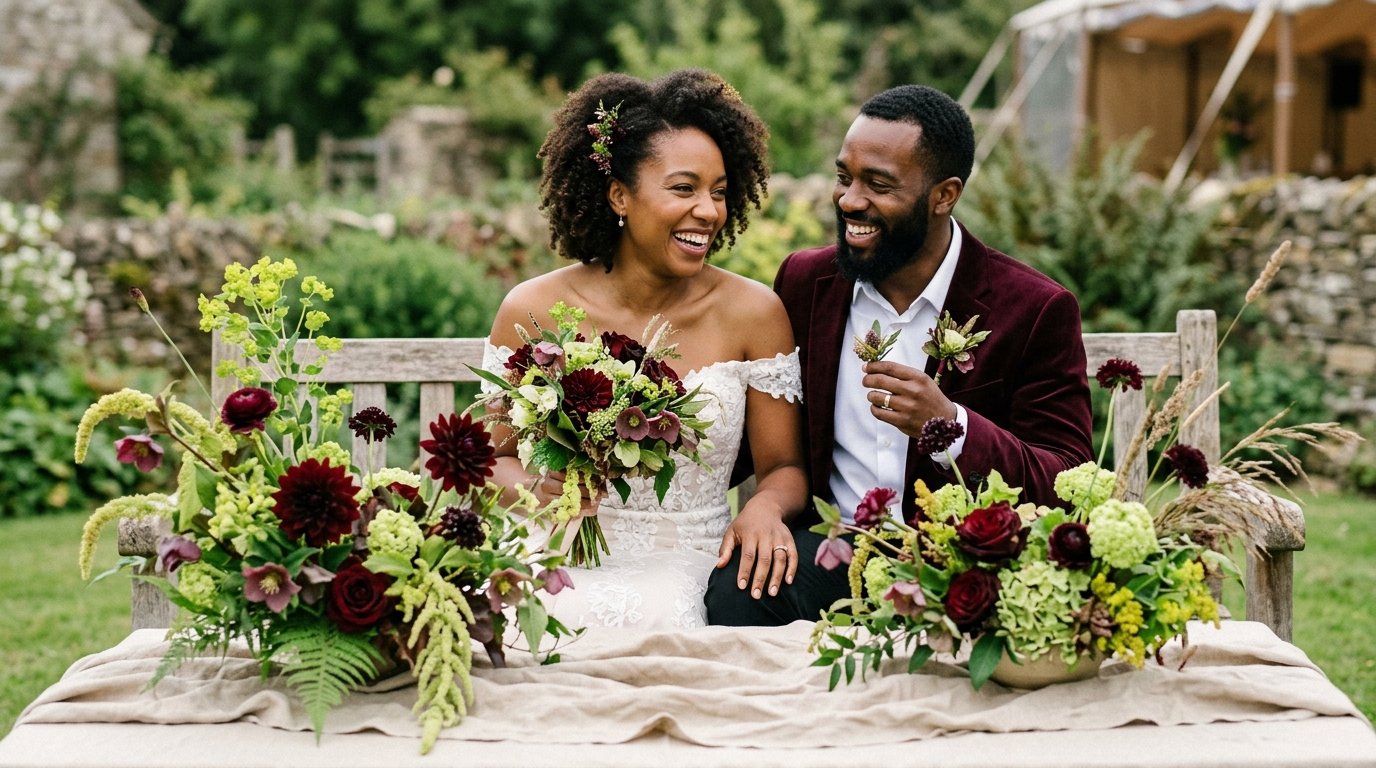
Floral choices define whether this palette reads as dramatic or jarring.
Burgundy side
Deep burgundy dahlias — varieties like ‘Chat Noir,’ ‘Karma Chocolate,’ and ‘Mystery Day’ — are the defining flowers. Their dark wine-red petals and layered structure create depth. In season UK-wide from July to October. Price: £2.50-£6 per stem from UK growers in peak season.
Marsala peonies — a deep, warm red-pink. The peony variety ‘Red Charm’ is the closest to true marsala. In UK season May to July. Price: £3.50-£7 per stem.
Dark red garden roses — David Austin varieties ‘Darcey Bussell’ (deep crimson) and ‘Munstead Wood’ (rich purple-red) are the most commonly requested in this palette from UK florists. Available year-round. Price: £4-£8 per stem.
Chocolate cosmos — small, near-black flowers with a faint chocolate scent. Rare and extremely effective as a dark accent. UK growers in the Flowers from the Farm network occasionally stock them June-September.
Chartreuse side
Chartreuse chrysanthemums — the most practical source of acid chartreuse in UK wedding flowers. Available year-round, robust, and genuinely chartreuse rather than yellow or lime. Price: £1.50-£3 per stem.
Acid-green hellebores — available February-April from UK growers. A specialist choice with a distinctively pale acid colour. They do not last well out of water and require stem treatment.
Green hypericum berries — clusters of small green berries on arching stems. They provide structural interest and a softer chartreuse note than chrysanthemums. Available year-round from wholesale suppliers.
Bells of Ireland (Moluccella laevis) — tall stems of stacked green bells. Architectural and distinctive. In UK season June-August. Price: £1.80-£3.50 per stem.
Viburnum opulus — snowball viburnum in its lime-green form. Available April-June. Round clusters of acid green that create a meadow-adjacent feel within a more dramatic palette.
Bridesmaid dresses
Chartreuse bridesmaid dresses are the most-discussed element of this palette on UK wedding planning forums. They photograph exceptionally well — the acid yellow-green creates a visual pop against ceremony settings that pastel dresses do not.
The practical reality in May 2026: most UK bridal boutiques report 8-12 week lead times on chartreuse bridesmaid dresses due to demand outpacing stock. Brands currently supplying in this colour include:
- ASOS Edition — chartreuse satin midi from approximately £85
- Coast — acid-green structured satin midi at approximately £175
- Phase Eight — “citrus” shade (close to chartreuse) at approximately £200-£280
- Jenny Yoo (US brand, stocked by some UK boutiques) — ‘Honeydew’ colour is a reliable chartreuse option
The alternative: burgundy bridesmaid dresses with chartreuse floral accents in the bouquets. This is lower risk — burgundy bridesmaid dresses are widely available at all price points — but loses some of the palette’s boldness.
For the bride: an ivory or warm white gown sits naturally within the palette because it mediates between the two contrasting colours. A burgundy sash or belt on the gown can anchor the bride within the palette without making the dress read as dark.
Table styling
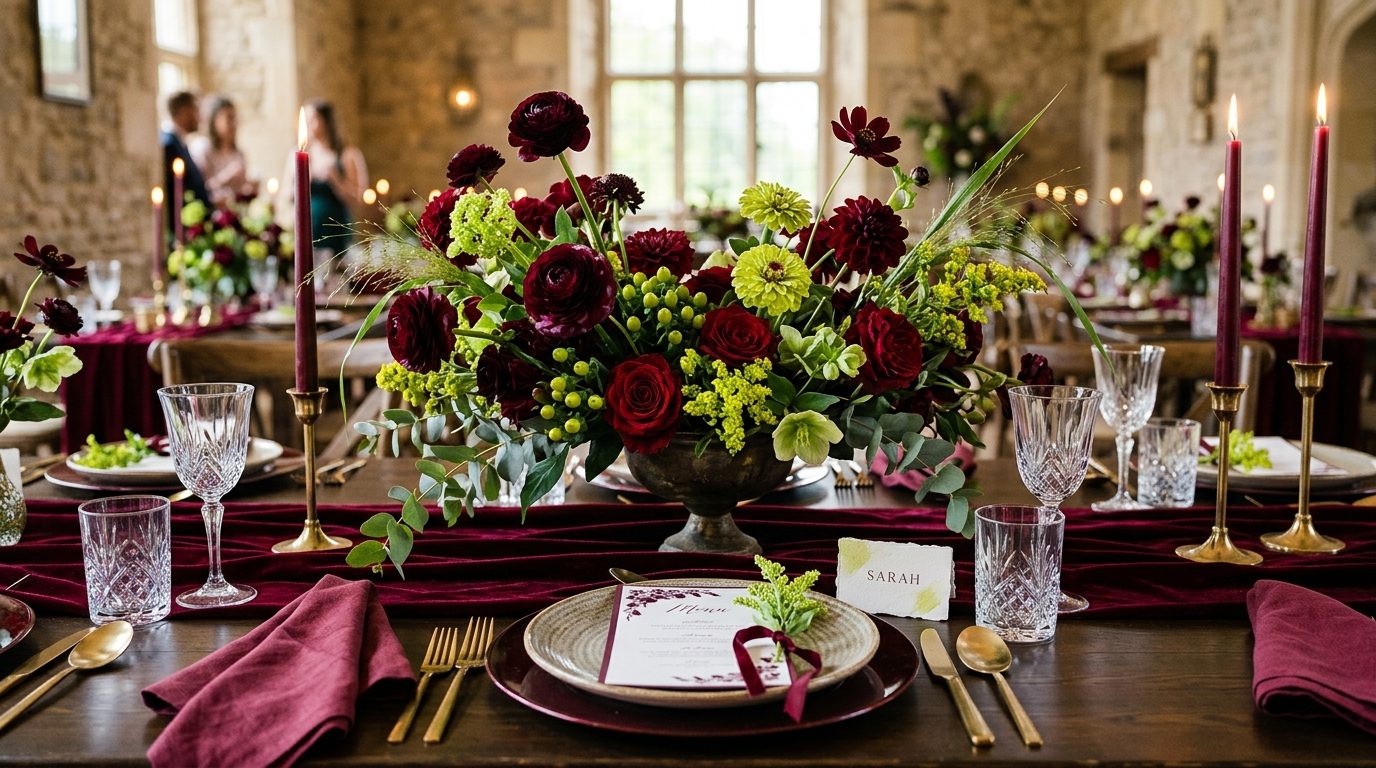
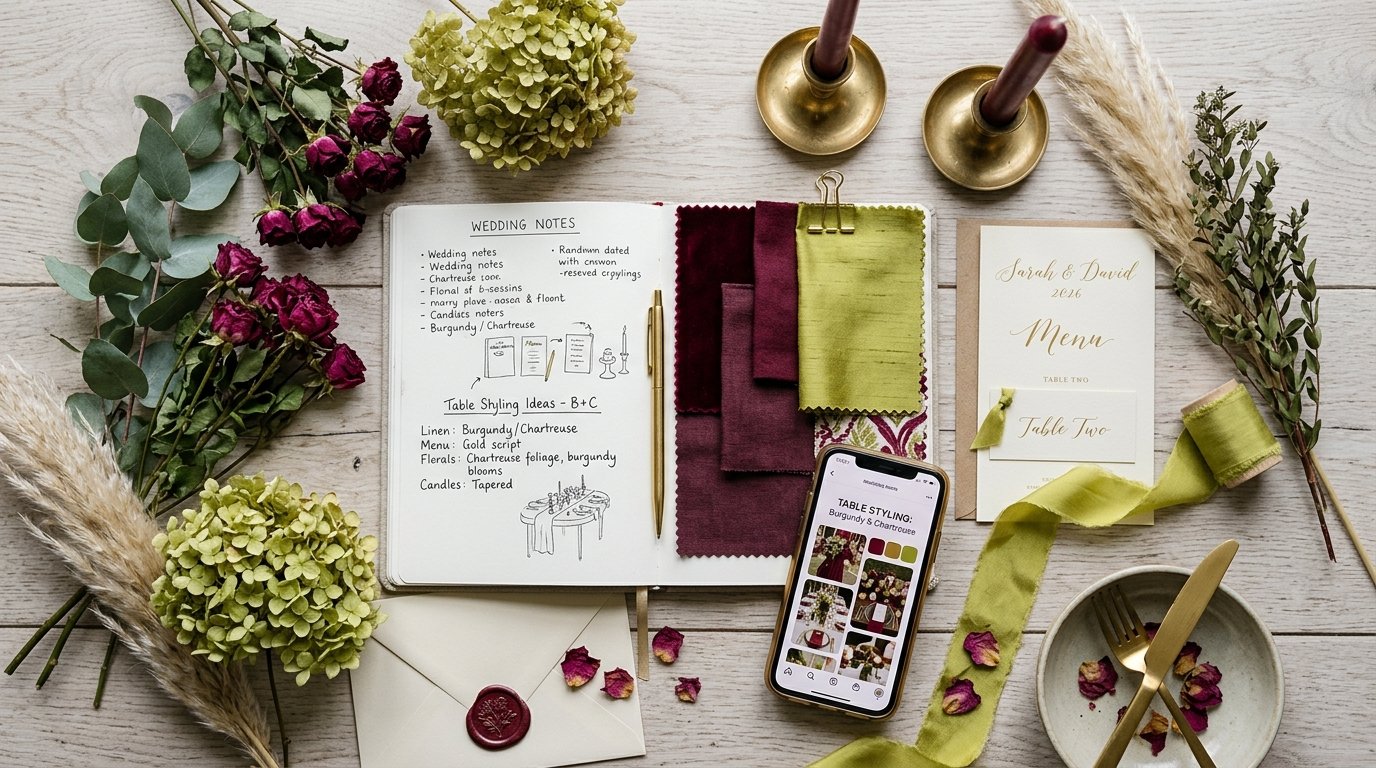
The tablescape is where this palette shows its full character.
Linens: Deep burgundy table runners over ivory or linen cloth. Do not use white — the contrast with chartreuse accents reads abrasive rather than dramatic. Alternatively, sage or dark green cloth with burgundy napkins.
Centrepieces: Tall, structured arrangements mixing burgundy dahlias or roses with chartreuse chrysanthemums and green hypericum. A few stems of bells of Ireland for height. Dense and rich — this is not a minimal palette.
Vessels: Dark vessels suit this palette. Antique brass, dark-oxidised copper, black ceramic, or deep bronze metallic. Clear glass works if the flowers are dense enough to carry the colour. Silver is incompatible — too cold.
Candles: Deep burgundy or midnight wine taper candles. Pair with small amber or gold votives for warmth.
Stationery: Dark burgundy card stock with gold or cream lettering. Chartreuse ink as an accent colour in venue signage works well.
Venues that suit this palette
The palette needs the right context. The wrong venue makes it feel garish.
Industrial and converted spaces — warehouses, factory conversions, railway arches, and Victorian engine houses. Dark brick, dark steel, and exposed structure create a backdrop that makes the burgundy depth and chartreuse sharpness read correctly.
Gothic stone churches and chapel venues — the cool grey stone and the drama of Gothic architecture sit compellingly against this palette. Some of the strongest photographs in this palette have come from Church of England autumn weddings where the stone interior provides the atmospheric backdrop.
Victorian and Edwardian manor houses with dark-panelled rooms — oak panelling and deep plaster mouldings suit this palette particularly well. Properties with strong period character give the palette the gravitas it needs.
What works less well: White-rendered barns, modern glass venues, light-filled orangeries. In these settings, significant extra floral investment is needed to prevent the chartreuse from looking out of place.
See our wedding colour schemes guide for help narrowing down your own palette.
Getting the proportion right
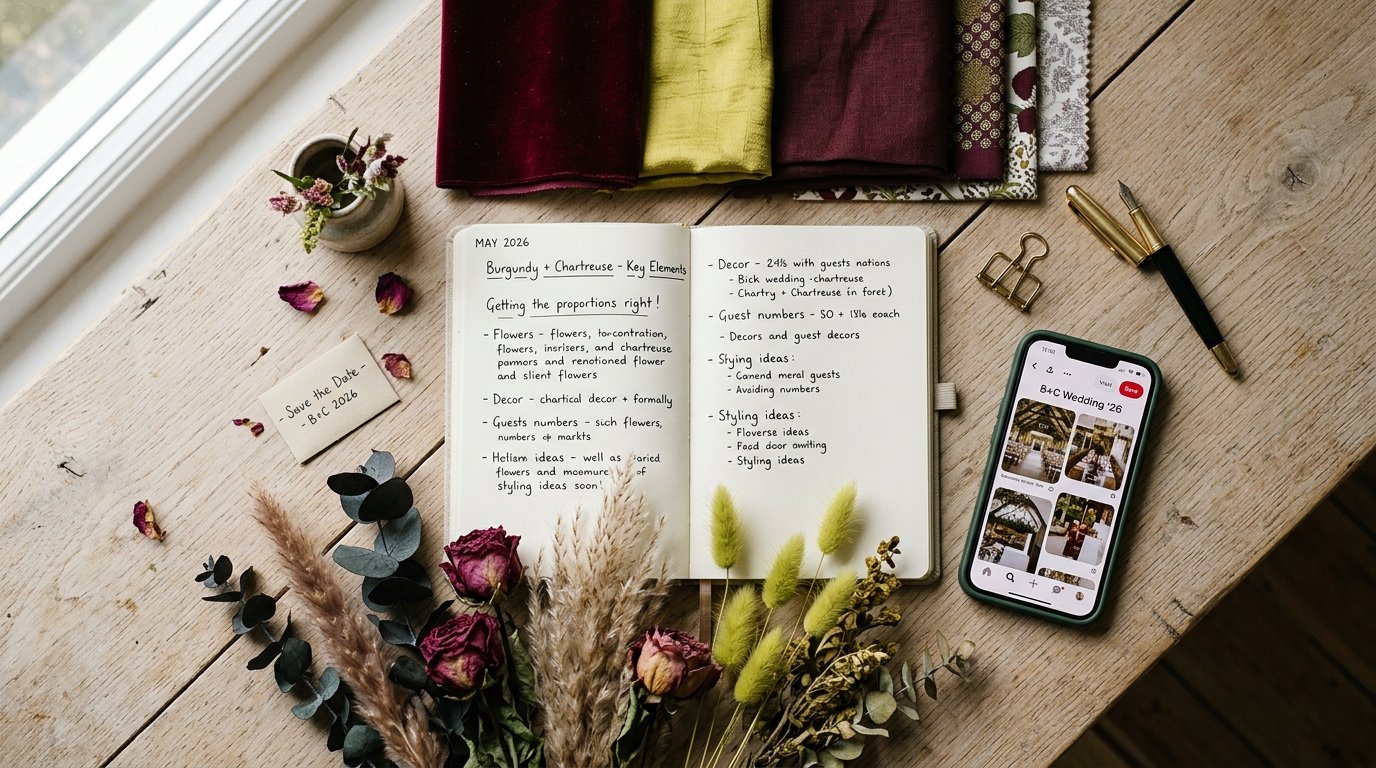
The single most important principle: burgundy leads, chartreuse accents.
In practice:
- Bridesmaid dresses: one chartreuse option and two burgundy, or all burgundy with chartreuse bouquets
- Table centrepieces: roughly 70% burgundy and dark red flowers, 30% chartreuse and green
- Decor: burgundy linens and vessels as the foundation, chartreuse as the punctuation mark
- Stationery: burgundy as the dominant colour, chartreuse as an accent line or border
Couples who have executed this palette well on social media have kept chartreuse as a controlled injection of energy. Used precisely, it reads as sharp and sophisticated. Used everywhere, it tips into comedy.
What time of year to plan for
Autumn is this palette’s peak season.
First, burgundy dahlias are at their best and cheapest from August through October when UK growers have full supplies. Out of season, expect to pay 40-60% more per stem for imported alternatives.
Second, the quality of October light suits this palette. Low-angle autumn light creates a warm, slightly golden cast that deepens burgundy and softens the sharpness of chartreuse. The resulting photographs tend to be more atmospheric.
Third, the venue heating requirements align. Dark industrial and Gothic venues are cold in winter. An October wedding achieves the same aesthetic without the additional heating costs.
Winter weddings in January-February can work by shifting from fresh flowers to dried arrangements and artificial foliage. The result feels more Victorian and structured — equally valid as a different interpretation of the palette.
Related articles
Frequently asked questions
Does burgundy and chartreuse actually work as a wedding palette?
Yes — the two colours are near-complementary on the colour wheel, which creates high visual contrast. The key is balance: use burgundy as the dominant colour (about 60-70%) and chartreuse as the sharp accent (30-40%). Reversing the ratio makes the palette feel neon rather than dramatic.
What flowers work for a burgundy and chartreuse wedding?
Deep burgundy dahlias, marsala peonies, and dark red garden roses for the wine side. Acid-green hellebores, chartreuse chrysanthemums, green hypericum berries, and bells of Ireland for the chartreuse side. Mix both colours in each arrangement rather than keeping them separate.
What bridesmaid dress colour works with this palette?
Chartreuse bridesmaid dresses with burgundy bouquets create the sharpest contrast. Alternatively, burgundy bridesmaid dresses with chartreuse floral accents. A split — some bridesmaids in each colour — works well for larger wedding parties.
What venues suit a burgundy and chartreuse wedding?
Dark interiors work best: exposed brick, dark wood panelling, industrial spaces, and gothic stone churches. The contrast between the deep wine red and the acid yellow-green reads most clearly against neutral or dark backgrounds. White-painted venues flatten the effect.
What season suits the burgundy and chartreuse palette?
Autumn and winter — October through February. Burgundy dahlias peak August through October; chartreuse provides the acid counterpoint that prevents the palette feeling heavy. Late summer also works well as both burgundy and acid-green foliage are at peak in August and September.
Is this palette too bold for a traditional wedding?
The palette can be calibrated. Using a muted, sage-adjacent chartreuse (rather than acid yellow-green) reduces the contrast significantly. An ivory gown rather than stark white mediates the two colours. The venue does most of the contextual work — a gothic church or industrial space normalises the drama.