How Long Should an Engagement Be?
Key Takeaways
- The average UK engagement lasts 18 months — but there's no 'correct' length
- 12-18 months is the sweet spot for most couples: enough time to plan without dragging
- Short engagements (under 6 months) work if you're flexible on venue and suppliers
- Long engagements (2+ years) are fine but can lead to planning fatigue — pace yourself
- The right length depends on your venue availability, budget timeline, and personal preference
There’s no rule about how long an engagement should last. Some couples get engaged on Saturday and married on Wednesday. Others enjoy a two-year engagement with a leisurely planning process. Both approaches produce perfectly good marriages.
What matters is choosing a timeline that works for your practical circumstances and your emotional preference.
Average engagement length in the UK
| Length | % of UK Couples | Typical Situation |
|---|---|---|
| Under 6 months | 10% | Spontaneous, second marriages, pregnancy, or “why wait?“ |
| 6-12 months | 20% | Efficient planners, off-peak dates, smaller weddings |
| 12-18 months | 30% | The most common range, comfortable pace |
| 18-24 months | 25% | Popular venue wait times, saving period |
| Over 2 years | 15% | Saving heavily, waiting for the right life stage |
Average: approximately 18 months.
Short engagement (under 6 months)
When it works
- You’re flexible on date, venue, and suppliers
- You want a small or intimate wedding
- You’re opting for a register office + restaurant
- You’re getting married for a second time
- You have the budget ready
- You simply don’t want to wait
Pros
- High energy and excitement throughout
- Less time for decision fatigue and over-planning
- Lower risk of “engagement drift” (losing momentum)
- Forces decisive action — you don’t have time to agonise over napkin colours
Cons
- Limited venue choice (popular venues book 12-18 months ahead)
- Limited supplier choice (top photographers and bands book early)
- Higher cost in some cases (last-minute bookings can be more expensive)
- Time pressure — wedding planning alongside daily life in 6 months is intense

How to make it work
- Choose a midweek or off-peak date — much more availability at short notice
- Book the venue first — everything else follows
- Book photographer and caterer immediately after the venue
- Consider a wedding planner (even on-the-day coordination) to handle logistics
- Use digital invitations to save 2-3 weeks on printing and posting
- Be decisive — choose the first option that’s good enough rather than searching for perfection
Standard engagement (12-18 months)
When it works
This is the sweet spot for most UK couples. Enough time to plan properly, save steadily, and enjoy the process without it consuming your life.
The timeline
| Month | Key Actions |
|---|---|
| 1-2 | Set budget, draft guest list, start venue search |
| 3-4 | Book venue, book photographer |
| 5-6 | Book caterer, DJ/band, florist |
| 7-8 | Order dress, book cake, send save-the-dates |
| 9-10 | Book remaining suppliers, plan ceremony content |
| 11-12 | Send invitations, first fittings, plan hen/stag |
| 13-15 | Seating plan, final fittings, confirm suppliers |
| 16-18 | Final month: confirmations, rehearsal, wedding day |
Full details: 12-Month Planning Timeline | Wedding Checklist

Long engagement (2+ years)
When it works
- You need time to save for the wedding you want
- Your dream venue has a 2-year waiting list
- You’re waiting for a specific life event (finishing university, moving house, having a baby)
- You’re simply not in a rush — some couples enjoy being engaged
Pros
- Maximum venue and supplier choice
- More time to save — less financial stress
- Longer to enjoy being engaged
- Can take advantage of sales and deals over a longer period
Cons
- Planning fatigue is real. The excitement of planning wears off after 12-18 months. By month 24, many couples are exhausted and just want it over.
- Pressure from others. “So when’s the wedding?” gets tiresome after the 50th time.
- Scope creep. The longer you plan, the more ideas you accumulate, the more the budget expands.
- Life changes. Jobs, homes, health, and relationships can shift over 2+ years, potentially changing your wedding plans.
How to manage a long engagement
- Set the date early — even if it’s 2 years away, having a date focuses the mind
- Don’t start planning immediately — enjoy 6 months of being engaged before opening a spreadsheet
- Pace your booking — book the venue early, then space out other bookings
- Set a budget and stick to it — long engagements tempt overspending (“we’ve got time to save a bit more”)
- Ignore pressure — your timeline is your business
How to decide what’s right for you
Ask yourselves these questions
- When is our dream venue available? If it’s booked for 18 months, that sets your minimum engagement length.
- How much do we need to save? Calculate the gap between your current savings and your wedding budget. Divide by what you can save monthly. That’s your minimum timeline.
- How much planning energy do we have? If you both work demanding jobs, a longer engagement gives more breathing room. If one of you is a natural planner with time, shorter works.
- Are there external deadlines? Pregnancy, visa requirements, military deployment, or family health concerns may dictate timing.
- What feels right? Some couples feel the pull to marry quickly. Others enjoy the anticipation. Trust your instinct.

Decision framework
| Situation | Recommended Length |
|---|---|
| Small wedding, flexible on date | 3-6 months |
| Standard wedding, popular venue | 12-18 months |
| Large wedding, premium venue | 18-24 months |
| Need to save significantly | 18-30 months |
| Second marriage, intimate | 3-9 months |
| Register office + restaurant | 1-3 months |
What to do first after getting engaged
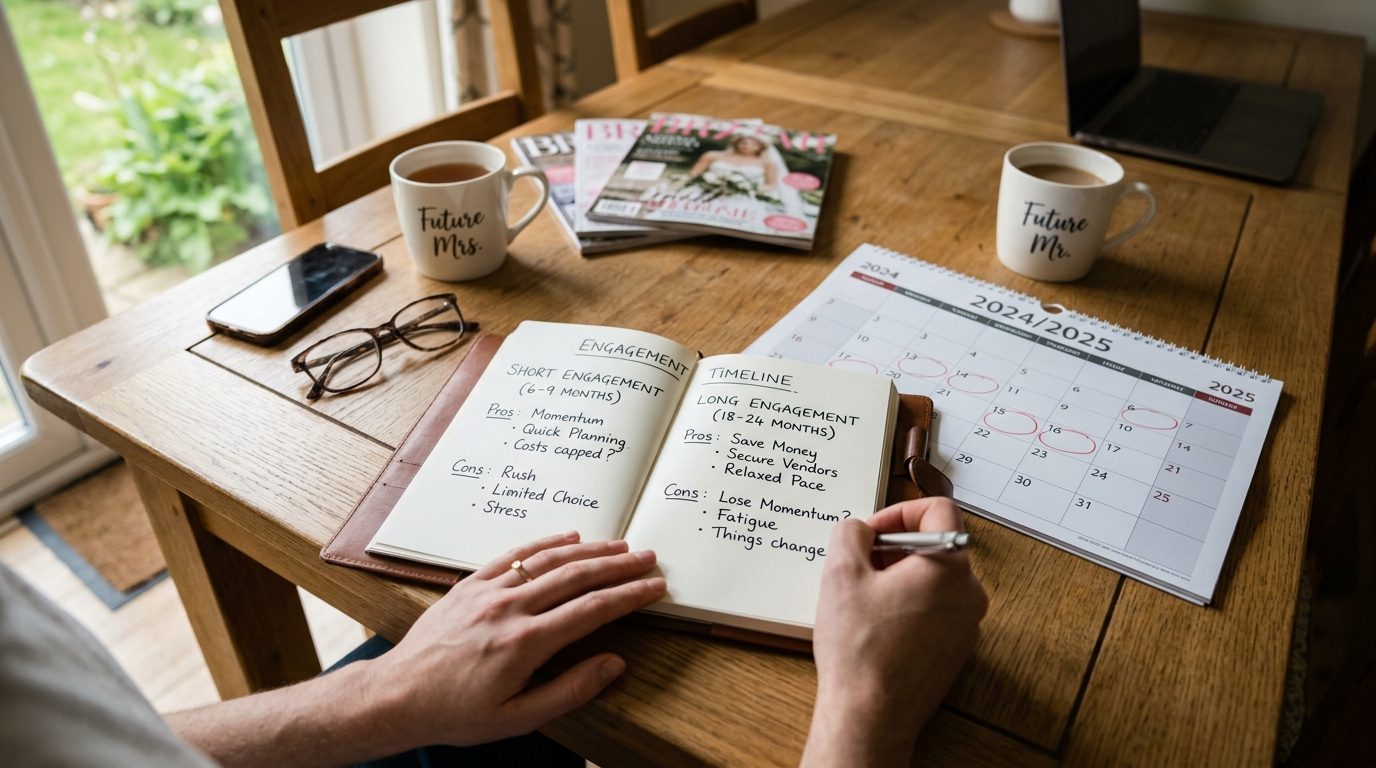
- Enjoy it. Don’t open a spreadsheet on day one. Take 2-4 weeks to celebrate, tell people, and simply be engaged.
- Set a budget. This determines everything. How to Budget
- Draft a guest list. Rough numbers, not a final list. This determines venue size.
- Start looking at venues. The venue sets the date, and the date starts the clock.
- Buy wedding insurance. As soon as you pay the first deposit. Insurance Guide
Further reading
- How to Plan a Wedding — the complete step-by-step
- Wedding Checklist — the full tick-list
- 12-Month Planning Timeline — month by month
- Engagement Party Ideas — celebrate the engagement
- Engagement Announcement Ideas — sharing the news
- Proposal Ideas — if you’re still planning the question
Frequently asked questions
How long is the average engagement in the UK?
The average UK engagement lasts approximately 18 months. Around 30% of couples are engaged for over two years, 50% for 12-24 months, and 20% for under 12 months. The trend is towards longer engagements, partly because popular venues book 18-24 months ahead for peak dates.
Is 6 months too short for an engagement?
No, but it requires flexibility. You'll have fewer venue and supplier choices at short notice, especially for summer Saturdays. Midweek, off-peak, or winter dates are much easier to book at 6 months' notice. Some couples prefer the energy of a short engagement — it keeps the momentum and excitement high.
Is 3 years too long for an engagement?
Not inherently, but planning fatigue is real. If you got engaged and deliberately set a date 3 years out, that's a choice — some couples save for longer or wait for the right life stage. If you've been engaged for 3 years and haven't set a date, it's worth discussing what's holding you back.
When should we start planning after getting engaged?
Enjoy the engagement for 2-4 weeks before starting to plan. Then: set a budget (week 1 of planning), draft a guest list (week 2), and start looking at venues (weeks 3-8). The venue sets your date, which starts the planning clock. Once the venue is booked, everything else follows a natural timeline.
Can you plan a wedding in 3 months?
Yes, if you're flexible. A register office ceremony can be arranged in 29 days (the legal minimum notice period). A full wedding with venue, caterer, photographer, and DJ is achievable in 3 months if you choose available suppliers rather than waiting for your first choice. Off-peak and midweek dates give you the most options.