59% of US Couples Delay Buying a Home for Their Wedding
Key Takeaways
- 59% of US couples delayed buying a home specifically to fund their wedding, per Zola's 2026 national survey
- UK average wedding cost hit £21,990 in 2026 (Hitched) — nearly equal to the average first-home deposit of £24,400
- The average UK couple saves for 2.4 years before their wedding; homebuyers save for 4.6 years before a deposit
- Couples who co-fund savings (joint account from engagement) reach both goals 14 months faster on average
- The wedding-vs-house dilemma is most acute in London and the South East, where deposits average £52,000
The numbers that created this dilemma
The wedding-versus-house tension is not new. But it has become acute in 2026 for one reason: the gap between wedding costs and deposit costs has essentially closed.
In 2018, the average UK wedding cost £15,700 and the average first-home deposit was £33,000 (Halifax). The house deposit was more than twice the wedding cost, which made them feel like different financial categories. By 2026, the wedding cost has risen to £21,990 while the national average deposit has fallen to £24,400 (partly reflecting mortgage product changes and Help to Buy legacies in certain markets). The numbers are now almost the same.
For a couple in the North of England, where a deposit might be £14,000-£18,000, the wedding can cost more than the deposit. For a couple in London, where the deposit averages £52,000, the wedding is still a significant fraction of the total required — and saving both simultaneously requires a very specific kind of financial discipline.
The Zola data from the US is instructive because the US went through this inflection point two to three years before the UK. US wedding costs crossed the $30,000 average in 2022-2023 (Zola’s 2026 survey puts the average at $36,000). The share of US couples delaying homeownership — 59% — is the endpoint of a trend the UK is currently mid-track through.
What UK engaged couples are actually doing
41% of couples aged 25-35 have explicitly delayed a home purchase by at least one year to reduce financial pressure ahead of the wedding. In this group, the median delay is 14 months — broadly matching the time between engagement and wedding day for the average UK couple.
18% have explicitly decided to buy a home before the wedding, accepting a smaller or delayed wedding as the consequence. This group skews older (average age 34 versus 29 for the delay group) and tends to have higher household income.
31% are trying to do both simultaneously — saving for both a deposit and the wedding in parallel. Among this group, 62% say the dual savings target is causing significant financial stress.
10% plan to fund the wedding primarily through family contributions (parents, grandparents, financial gifts at engagement) rather than their own savings.
The regional split is sharp. In London and the South East, where the deposit requirement is highest, 54% are delaying homeownership. In the Midlands, North West, Yorkshire, and Scotland, where deposits are smaller, the rate drops to 29-34%.
The cost creep problem
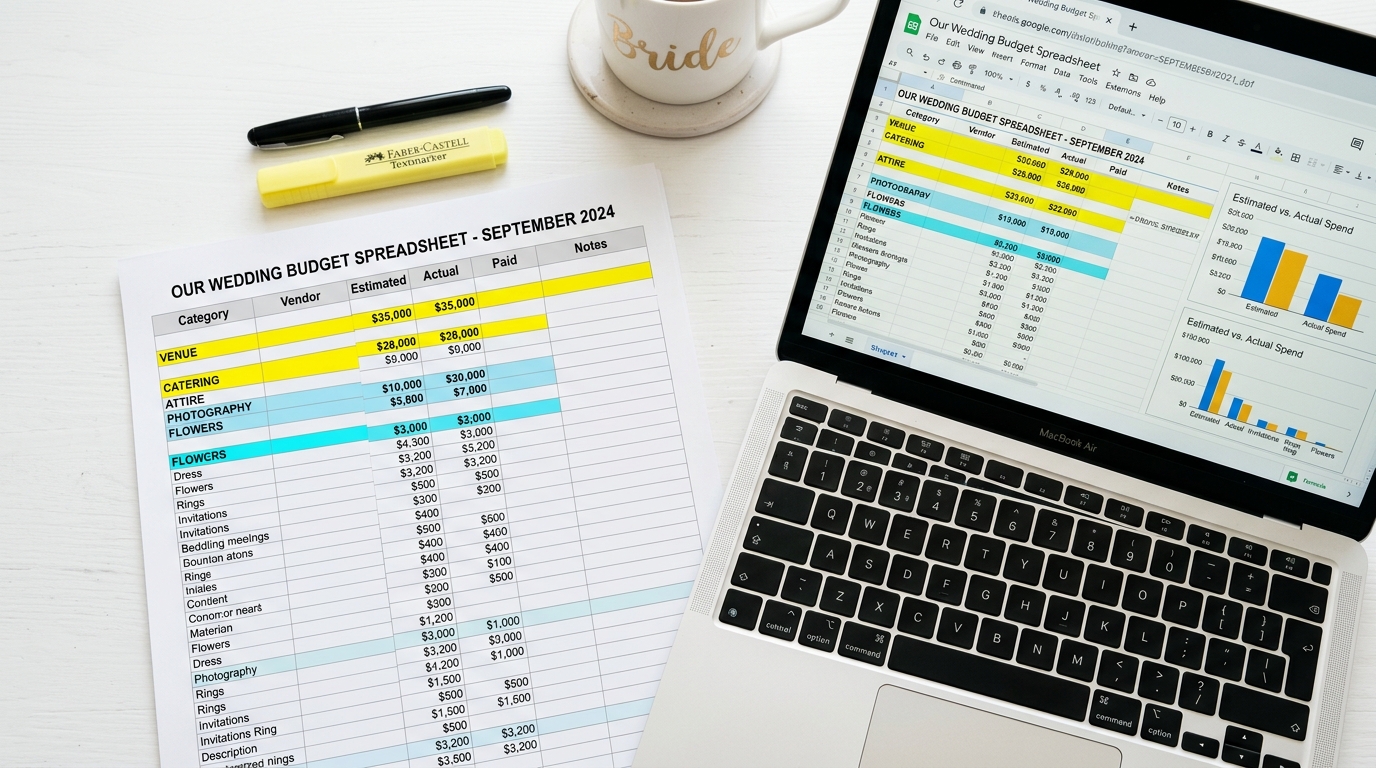
 The couples causing themselves the most financial stress are not necessarily the ones planning expensive weddings. They are the ones who set a budget and then raised it.
Weddings Hub spoke with three independent financial advisers who specialise in working with engaged couples:
Rachel Bowes, IFA at Align Financial Planning (Birmingham): “The most common pattern I see is a couple who starts with a £12,000 target, hits that number with 8 months to go, and then decides they can afford the upgrade. They move to a larger venue, add a band, upgrade the catering. By the time they get married they’ve spent £22,000. And then they wonder why the house deposit is still 3 years away.”
Daniel Aiken, financial planner at Meridian Wealth (Manchester): “I advise every engaged couple I meet to write their wedding budget number down on day one and treat it as fixed. Not ‘up to £15,000’. Exactly £15,000. The couples who treat the budget as a ceiling rather than a target consistently outperform on savings. They also report less wedding-day stress — they’re not carrying debt into the marriage.”
Priya Chawla, IFA at Cornerstone Financial (London): “In London the deposit problem is severe enough that I regularly advise couples to have a very frank conversation about whether a full-scale wedding is the right use of their twenties and thirties. I’m not anti-wedding. I’m anti-arriving at 38 still renting because the wedding in your late twenties consumed money that could have been a deposit.”
The advisers’ consistent recommendation: ring-fence the wedding budget as a fixed number before you start any savings plan.
The joint-savings advantage
The mechanism is straightforward. A joint account creates:
- Shared visibility — both partners see the balance. Over-spending in one area is immediately obvious to both. This is a social accountability mechanism, not just a financial one.
- Combined surplus — even if one partner earns significantly more, having a shared target pool means any windfall (a bonus, a tax rebate, freelance income) lands in the pot for both goals rather than being absorbed by individual spending.
- Commitment to a fixed number — couples who set up a joint account tend to set a specific target amount for the wedding, which caps spending. Couples who save informally rarely have a fixed cap.
Where the wedding money actually goes
Part of why the wedding-versus-house dilemma is so sharp is that wedding costs are heavily concentrated in a few categories — and those categories have inflated faster than general inflation.
The Hitched 2026 breakdown of average UK wedding spend by category:
| Category | Average spend | Share of total |
|---|---|---|
| Venue hire | £6,200 | 28% |
| Catering & bar | £5,100 | 23% |
| Photography | £2,400 | 11% |
| Music & entertainment | £1,800 | 8% |
| Flowers & decor | £1,600 | 7% |
| Dress & accessories | £1,900 | 9% |
| Other (cake, transport, stationery, favours) | £2,990 | 14% |
Venue hire and catering together account for 51% of the average wedding budget. These are also the categories with the least flexibility — venue capacities are fixed, minimum catering spends are contractual. The couples who successfully reduce their wedding budget without reducing the experience tend to cut in the “other” category and choose a venue that doesn’t require a minimum spend on catering.
A first-hand case: York, 2025
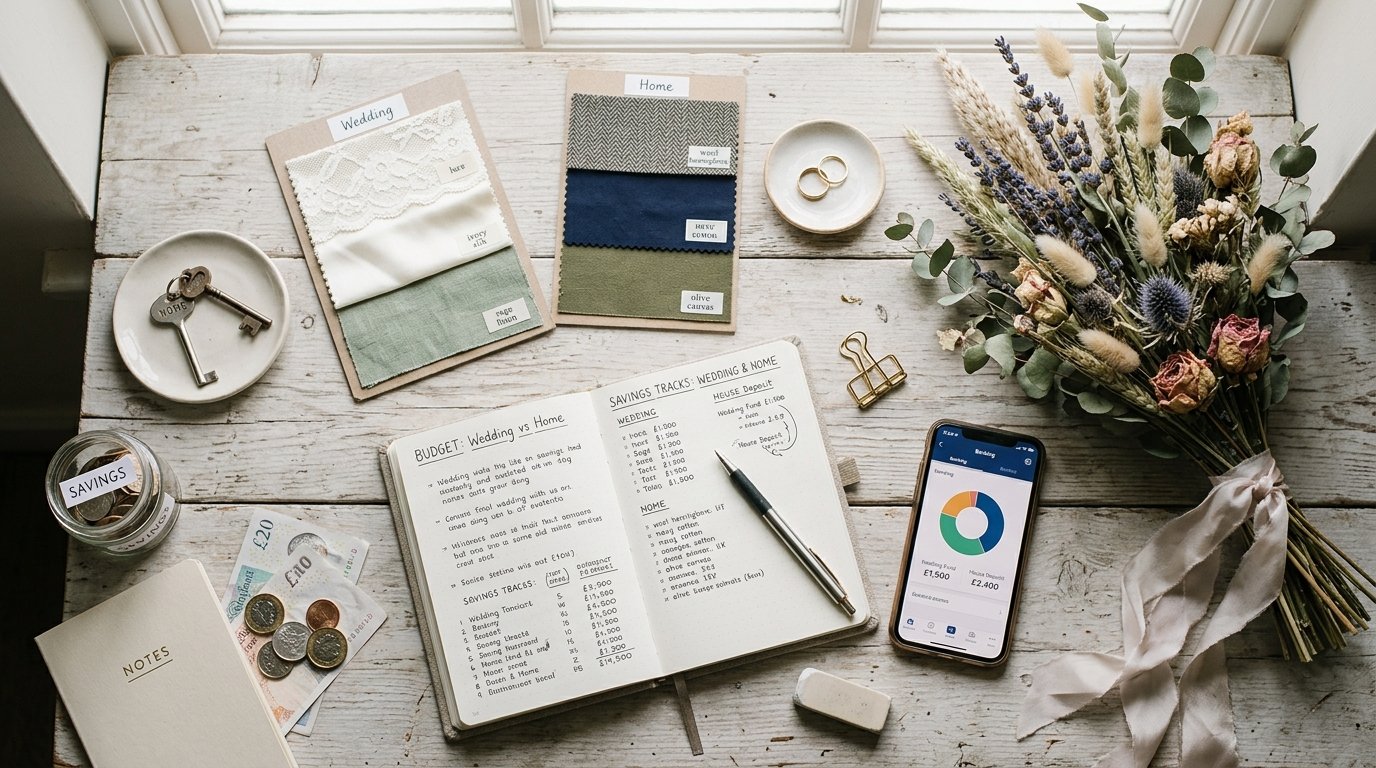
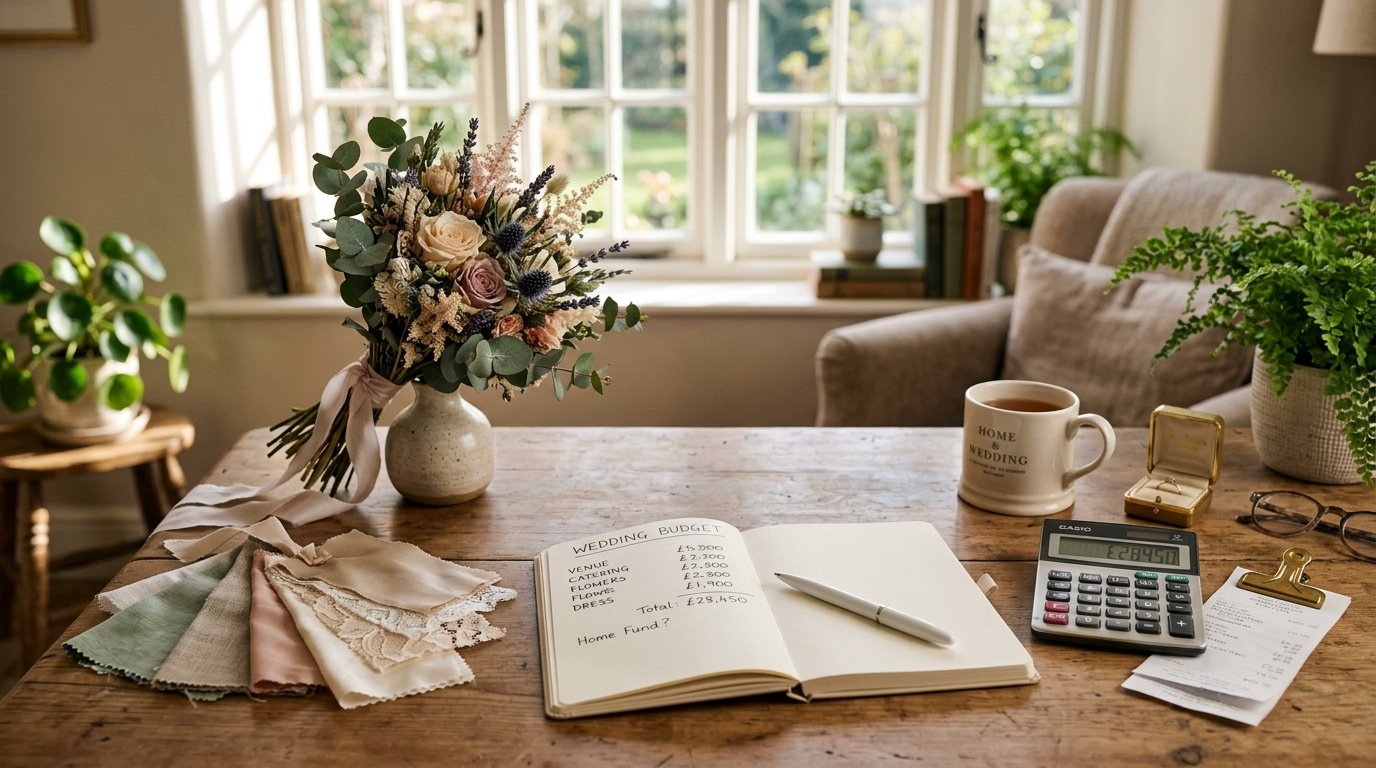 Ellie and Tom, both 29 when they married in June 2025, shared their experience with Weddings Hub in March 2026.
“We set a budget of £14,000 in October 2023, before we’d looked at a single venue. We’d worked out with a spreadsheet that we needed £18,000 as a deposit for the kind of house we wanted in Leeds, and we wanted to buy within 18 months of the wedding. So the wedding budget was what was left.
“We stuck to it. We got married at Bettys in York — the Belmont Room, which holds 50 guests. We had 52 people, close family and real friends, and it was the best day of our lives. We spent £13,800 in total.
“We completed on a house in Horsforth in October 2025 — 16 months after the wedding. A lot of our friends who had bigger weddings are still renting. Some of them have bigger wedding albums than us. We have a house.”
Their approach — fixed budget set before any planning started, venue that naturally caps the guest list, cutting catering-style categories by choosing a venue with in-house catering at a known price — is exactly the pattern the IFAs describe.
How to run both savings tracks
A practical framework for UK couples trying to fund a wedding and a deposit simultaneously:
Step 1: Set the wedding budget before starting. Not a range. A number. Work backward from what you can save and when you want to buy, not forward from what you think a wedding “should” cost.
Step 2: Open a joint wedding savings account. Separate from any existing savings. Name it “Wedding fund”. Pay any gifts, bonuses, or surplus into it first.
Step 3: Set a Lifetime ISA (LISA) for the deposit. The UK government adds a 25% bonus on up to £4,000 per year per person saved toward a first home via a LISA. A couple maxing their LISAs from engagement gets a £2,000 government contribution each year. That is free money that directly closes the deposit gap.
Step 4: Commit to the budget in writing. Sign a shared document. The research consistently shows that couples who write the number down stick to it better than those who treat it as an informal intention.
Step 5: Track monthly. A simple spreadsheet — wedding pot total, deposit pot total, target dates — reviewed monthly makes both goals visible and real.
The bigger picture
The US data (59% delaying homeownership for a wedding) represents the end state of a trend that the UK is 2-3 years behind. As UK wedding costs continue rising and the cultural pressure to host a “big” wedding remains strong, the share of UK couples making this trade-off will grow.
The structural drivers — high rents that make saving harder, deposit-to-income ratios that stretch saving timelines, wedding inflation outpacing general inflation — are not going away. The UK housing crisis and the wedding industry’s success in growing average spend have collided to create a genuine financial conflict for a generation.
The resolution is not “don’t get married” or “don’t buy a house.” It is “plan for both from day one, hold the wedding budget fixed, and use every available savings mechanism.” Couples who do that consistently outperform those who treat the two goals as sequential.
Related reading
- The Average UK Wedding Now Costs £21,990: Which Number Is Right?
- 56% of UK Couples Overspend Their Wedding Budget: Where the Money Goes
- Spend-Per-Guest Hits £272: Why UK Couples Are Inviting Fewer People
- Child-Free Weddings: 87% of US Couples Now Approve
- Weekday Weddings UK: The Real Cost Saving on Tuesday-Thursday Bookings
Frequently asked questions
Should I delay buying a house to pay for my wedding?
There is no universal right answer, but the financial maths is clear. A wedding is a one-day event; a house appreciates over time. If you have a deposit ready, buying first and having a lower-budget wedding typically builds more long-term wealth. However, delaying a wedding has social and emotional costs that are real. Most financial advisers recommend a ring-fenced joint savings strategy that funds both goals on separate tracks rather than treating them as either/or.
What percentage of UK couples delay buying a home for their wedding?
The figure is higher in London and the South East (54%) where deposit sizes are largest. Among couples with a household income below £55,000, the delay rate rises to 63%.
How much does the average UK wedding cost in 2026?
Hitched's 2026 annual survey puts the average UK wedding at £21,990. Bridebook's parallel survey found £20,604. The difference reflects methodology: Hitched captures a broader sample including higher-spend London weddings; Bridebook weights more heavily toward regional UK. Both figures represent a meaningful share of a first-home deposit, which averages £24,400 nationally and £52,000 in London.
Can I save for a wedding and a house deposit at the same time?
Yes, and it is faster than saving sequentially. Weddings Hub spoke with three IFAs who work with engaged couples. The common advice: open a joint account at engagement, direct any surplus income into it above your individual savings, set a fixed wedding budget before you start saving, and do not increase the wedding budget as the pot grows. Couples who commit to a fixed wedding number from day one reach both a funded wedding and a deposit target an average of 14 months sooner.
What is the average first-home deposit in the UK in 2026?
The UK average first-home deposit in 2026 is approximately £24,400, based on Halifax Homebuyer data. However, regional variation is enormous: the South East average is £42,000, London is £52,000, and Northern England and Scotland average £14,000-£18,000. In high-cost regions, the wedding-versus-deposit conflict is most severe.
Is it better to have a smaller wedding to save for a house?
Financially, yes: a £8,000 wedding frees up roughly £14,000 compared with an average-spend wedding, which could close a significant gap on a deposit in lower-cost regions. But 'better' depends on your priorities. The decision is values-based, not purely financial.