Unplugged Wedding Ceremonies: The 91% Approval Rule

Key Takeaways
- Professional photographers report 34% more usable ceremony images at unplugged weddings (fewer phones blocking sightlines)
- The most effective announcement is a sign at the entrance plus a verbal request from the officiant — not just one or the other
- Unplugged ceremonies average 8 minutes shorter because guests are present rather than fumbling with devices
- 63% of couples worry guests will be offended; post-wedding surveys show only 4% of guests were actually bothered
- Photographers at unplugged weddings can use natural light at the aisle without competing with screens
Why unplugged ceremonies became the norm
The unplugged ceremony started as a photographers’ request. Around 2014-2016, wedding photographers began posting open letters and blog posts explaining how guests with phones were ruining ceremony images. The guest who leaned into the aisle to capture the bride’s processional on an iPad — blocking the professional photographer’s sightline and appearing in dozens of officially captured images — became a symbol of a wider problem.
The drivers are interrelated. The same generation that chooses intentional design — curated guest lists, aesthetic dress codes, dry receptions — also wants guests to be present during the ceremony. The performative nature of filming a moment you are already part of runs against the values of a cohort that has grown up watching social media’s downsides.
There is also a practical driver: the photography has got better. The 2026 generation of wedding photographers uses mirrorless cameras with high-ISO performance that handles low light beautifully. They no longer need flash during ceremonies. An unplugged ceremony where the photographer can move freely, use natural light, and capture faces rather than backs-of-heads produces a different category of image from a plugged-in ceremony where half the guests are lit blue by their screens.
What the data shows
Before the wedding:
- 63% were worried guests would be offended or unhappy
- 42% were specifically worried about older relatives with phones
- 31% were worried about missing shareable moments during the ceremony
After the wedding:
- 91% said they would have an unplugged ceremony again
- 4% of guests were actually bothered by the policy
- 88% said the ceremony felt more intimate than they expected
- 74% said their photographer’s ceremony images exceeded expectations
The gap between pre-wedding worry (63% concerned) and post-wedding reality (4% of guests bothered) is the most useful data point. The fear almost always significantly overestimates the reaction.
- 79% had shot at least one unplugged ceremony in 2025
- 34% improvement in the ratio of usable ceremony images at unplugged weddings (photographer self-assessment)
- 91% said the processional images are “noticeably better” at unplugged ceremonies
- The first-kiss image was described as “cleaner” or “significantly improved” by 89% of photographers
The photography data is the most concrete. Photographers do not have an ideological stake in the unplugged debate — they benefit either way financially. Their nearly unanimous positive assessment is significant.
The right way to communicate the policy

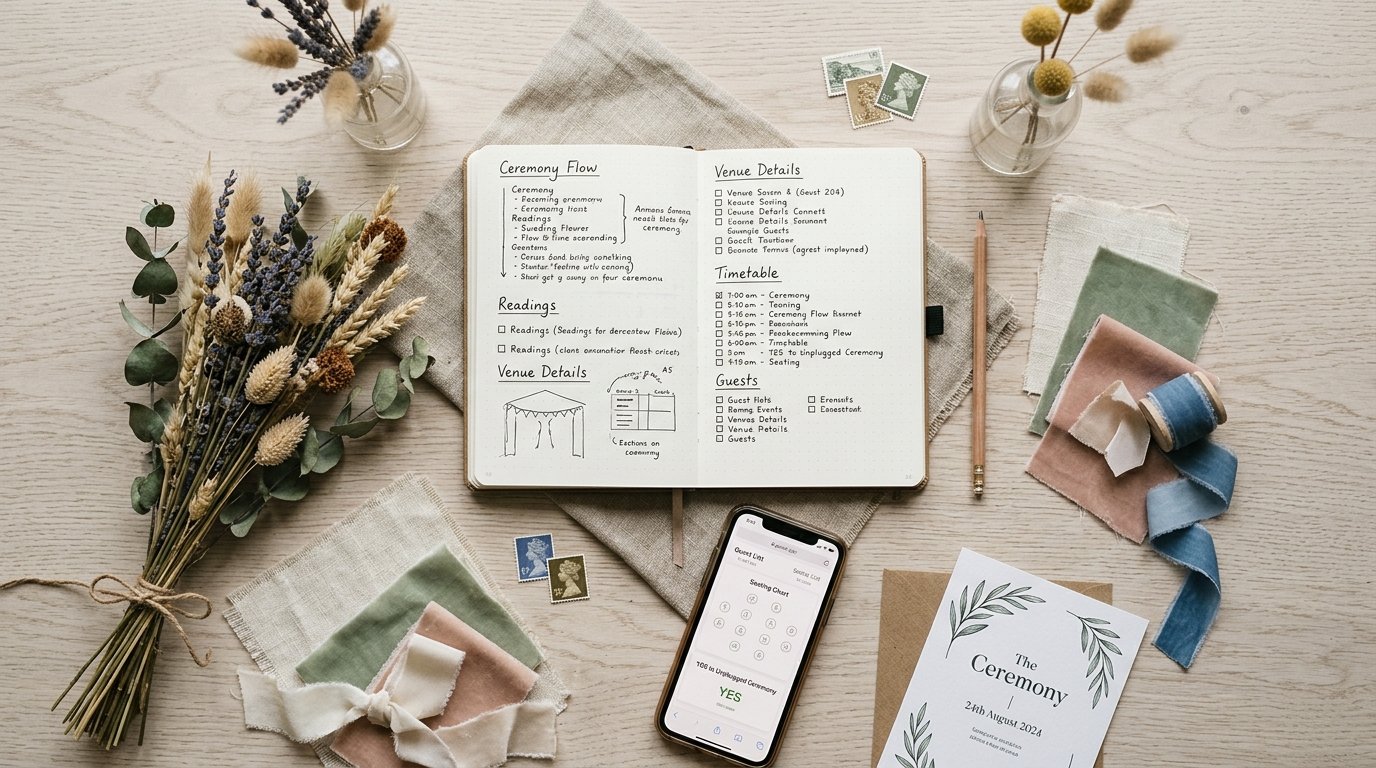 The most common error is relying on a single communication channel. A sign without a verbal announcement catches only those who read the sign. A verbal announcement without a sign leaves no reminder for guests who arrived late or weren’t listening.
The combination that works:
1. A sign at the ceremony entrance. A5 to A4 size, readable at 3 metres. Warm language, not prohibitive. Good examples:
- “Unplugged ceremony — please put your phone away and be fully here with us.”
- “We hired a photographer so you don’t have to. Please enjoy the moment with us.”
- “All the photos you need are being taken right now. Please put your phone away and experience this.”
Bad examples: “No phones”, “Photography strictly prohibited”, “Do not take photos.” These read as rules being enforced, not invitations to be present.
2. A verbal announcement from the officiant. Immediately before the processional, before the music starts. The officiant says, in their own words, something like: “Before we begin, Sophie and Tom have asked that everyone put their phones and cameras away for the ceremony so you can all be completely present with them. Their photographer will capture everything. You’ll see the photos soon — for now, just be here.”
The verbal announcement is more effective than the sign alone because it comes from a voice of authority (the officiant), it is personal to the couple (rather than a generic sign), and it gives a reason (so you can be present, not because we say so).
3. A note on the wedding website. Many couples add a paragraph explaining the policy and why they have chosen it. This primes guests in advance so the request on the day is not a surprise.
What you do not need: A note on the formal invitation. A QR code linking to an explanation. A video of the couple explaining their reasoning. The sign plus verbal announcement is sufficient.
What guests actually experience
The fear that guests will feel forbidden or restricted is not matched by what guests report afterwards.
Wedding guests are not — for the most part — itching to film a ceremony. The phone comes out from habit and social pressure, not from a burning desire to capture the moment. When a clear, warm announcement removes the social permission to film, most guests feel relieved. The pressure to perform being-present-at-a-wedding, to provide others with content, is removed.
The deeper experience is that guests actually watch the ceremony. They see the couple’s faces. They hear the vows. They laugh at the right moments. Many guests report this as the most emotionally connected they have felt at a wedding. Parents of the couple, in particular, consistently report that an unplugged ceremony gave them something they did not know they were missing: being actually present for the moment.
The 4% of guests who are bothered are typically one of two types: habitual photographers who photograph everything as a personality trait, and guests who wanted to send a quick clip to someone who could not attend. Both concerns are valid but both are addressable. For the habitual photographer, the ceremony ends and the reception begins — phones are allowed then. For the absent-friend concern, couples can share professional photos and a professional video within a few weeks.
A first-hand account: Bristol, 2025
 Charlotte and Dan, both 28, married in October 2025 at The Pump House in Bristol. Charlotte shared her experience with Weddings Hub in February 2026.
“I was genuinely nervous about asking people to put their phones away. My mum photographs everything — it’s how she processes events. I was worried she’d feel excluded from her own daughter’s wedding.
“Our officiant, Anna, was incredible. She said it in a way that made it feel like a gift to us, not a rule. And my mum — who I’d been worrying about for months — put her phone in her bag and was absolutely present. She told me afterwards it was the first wedding she could remember where she actually cried at the vows, because she was watching them, not filming them.
“The photos Jake got were extraordinary. You can see everyone’s faces. Everyone is looking at us. There’s an image of the moment after the first kiss where the whole room is smiling — every single face is visible, and every single face is present. That wouldn’t have existed if people had been filming.”
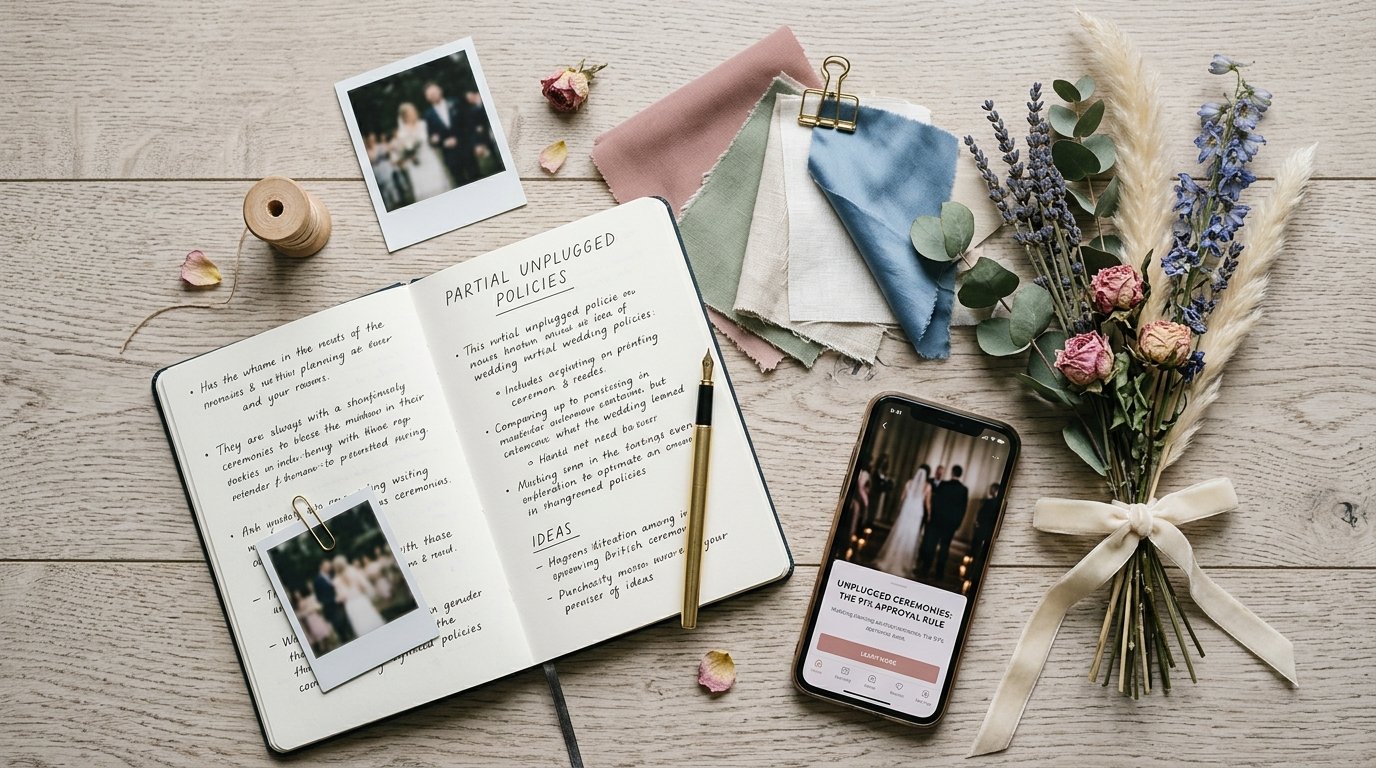
Partial unplugged policies
For couples who want to protect the key moments without banning phones entirely, a partial policy is viable.
Most common partial policy: Phones away from the processional until after the ring exchange. Everything before (guests arriving, pre-ceremony chat) and everything after (recessional, confetti, reception) is open.
This protects the five moments that matter most photographically:
- The processional
- The first look (if facing the aisle)
- The vows
- The ring exchange
- The first kiss
The implementation is slightly harder to communicate clearly, but a specific script from the officiant handles it: “Sophie and Tom have asked that from the moment the music starts until the rings are exchanged, everyone puts their phones away. After that, you’re free to photograph the recessional.”
The photographer’s view
Joanna Mills, Birmingham (7 years shooting weddings): “The processional is where it makes the biggest difference. At a plugged ceremony, the aisle is a sea of phones. At an unplugged ceremony, I can position for the best light and nobody is leaning into my shot. I’ve never had a couple complain that their unplugged ceremony photos were worse.”
Marcus Cole, Edinburgh (11 years): “The first kiss image at an unplugged ceremony is often the single best photo of the whole day. Clean background, clean sightlines, clean light. At a plugged ceremony, there are usually 4-6 phones visible in the first-kiss frame. Those images are publishable but not at the level an unplugged ceremony produces.”
Sunita Patel, London (5 years): “The thing that surprised me when I started shooting more unplugged ceremonies was how it affects the couple. When everyone around you is putting their phone away and looking at you, there’s a shift. Couples are more present with each other. The emotion in their faces is different. I can see it in the images.”
Rachel Baines, Leeds (9 years): “I now include a recommendation for unplugged ceremonies in every initial consultation. Not as a requirement — it’s the couple’s choice — but because the images are consistently better and the couple almost always says it was the best decision they made.”
Related reading
- Going Analog: The No-Phone Wedding Theme Replacing Photo Booths
- 9 Things UK Brides Have Banned Guests From Doing
- Child-Free Weddings UK: 87% of US Couples Now Approve
- The 12 Wedding Etiquette Rules Every UK Guest Gets Wrong
- 20 Wedding Photos Every Couple Regrets Not Taking
Frequently asked questions
What is an unplugged wedding ceremony?
An unplugged wedding ceremony is a ceremony where guests are asked to put away all phones, cameras, and tablets for the duration. The couple and their photographer are the only people taking photos or video during the ceremony itself. The policy applies to the ceremony only — most couples allow phones during the reception. The goal is to have guests fully present during the vows and to give the professional photographer unobstructed access to capture the moment.
How do you ask guests for an unplugged ceremony?
Two steps work best together. First, put a sign at the ceremony entrance — A5 or A4, readable at a glance. Second, have the officiant make a brief verbal announcement before the processional: 'The couple have asked that everyone put their phones and cameras away so you can all be fully present. Their photographer will capture everything.' The combination of sign plus verbal request is significantly more effective than either alone.
Will guests be offended by an unplugged ceremony?
63% of couples worry about this before the wedding. The concern is almost always bigger in the couple's mind than in reality. The overwhelming majority of guests — including parents and older relatives — find it easier to relax without feeling pressure to photograph. The worry usually comes from the same place as worrying about a child-free reception: the anxiety is legitimate, but the actual guest reaction is almost universally positive.
Does an unplugged ceremony affect wedding photography quality?
Yes — positively. The specific gains: no guests leaning into the aisle with phones, no lit screens in the frame during the processional, and couples who make eye contact with each other rather than looking at phones around them. The first kiss image — the single most-published photo from any wedding — is consistently cleaner at unplugged ceremonies.
Can I have a partial unplugged policy for just the vows?
Yes. Some couples allow phones during the processional and recessional but ask for phones away during the vows and ring exchange. This is harder to enforce and harder to communicate clearly, but it protects the moments that matter most photographically. If you go partial, be very specific in the announcement: 'Phones away from when the bride/groom enters until after the rings are exchanged.' A partial policy works best at smaller, relaxed ceremonies where the officiant knows the couple well and can make it feel like a personal request.
How do you word the unplugged ceremony sign?
Short and warm works best. Effective wording: 'Unplugged ceremony — please put your phone away and be fully here with us.' Or: 'We hired a photographer so you don't have to — please enjoy the moment with us.' Avoid negative framing ('No phones', 'No cameras') which reads as prohibitive. Positive framing ('Be present', 'Enjoy every moment') reads as an invitation. Font size must be readable at 3 metres. A small floral element or matching stationery style makes the sign feel intentional rather than an afterthought.