Church Wedding Requirements UK
Key Takeaways
- You need a 'qualifying connection' to marry in a Church of England church — living in the parish is the most common
- Banns must be read on three consecutive Sundays before the wedding — arrange this 3-6 months ahead
- Church weddings cost £500-800 total (fees + organist + bells + certificate)
- The vicar will require marriage preparation meetings — usually 2-3 sessions
- You don't need to be regular churchgoers, but you do need to meet the vicar and discuss the service
A church wedding in England is more structured than a civil ceremony. There are legal requirements, qualifying connections, and a process involving the vicar, the banns, and the diocese. But it’s less complicated than it sounds — and the vicar will guide you through every step.
This guide covers the Church of England specifically, with notes on Catholic and other denominations at the end.
Church of England: the basics
Who can marry in a Church of England church?
You must have a qualifying connection to the parish. At least one of the following must apply to at least one partner:
| Connection | Details |
|---|---|
| You live in the parish | Your home address is within the parish boundary (check at achurchnearyou.com) |
| You worship there regularly | You attend services at least once a month for 6+ months |
| You were baptised there | Either partner was christened at that church |
| You were confirmed there | Either partner was confirmed at that church |
| A parent was married there | Either partner’s parent was married at that church |
| A parent or grandparent lived in the parish | At any time during your lifetime |
| You attended a school in the parish | Either partner, and the school had a Church of England character |
If none of these apply, you can establish a connection by attending services regularly for 6 months. The vicar will add you to the electoral roll, which gives you the right to marry there. This is the most common route for couples who’ve chosen a specific church.
Step-by-step process
| When | What |
|---|---|
| 12-18 months before | Contact the vicar, check availability, discuss your connection |
| 9-12 months before | Confirm the booking, arrange marriage preparation meetings |
| 6 months before | Arrange the reading of banns (vicar will guide you) |
| 3 months before | Banns are read (three consecutive Sundays) |
| 1 month before | Attend the rehearsal, confirm ceremony details |
| Wedding day | Arrive on time, the vicar handles everything |
Marriage preparation
Most vicars require 2-3 marriage preparation sessions before the wedding. These are not religious tests — they’re conversations about your relationship, communication, expectations, and what marriage means.
Expect to discuss:
- Why you want to marry in church
- Your relationship history and how you met
- How you handle disagreements
- Your views on family, children, and finances
- The meaning of the marriage vows
These sessions are usually relaxed and informal. Many couples find them genuinely helpful.
The banns
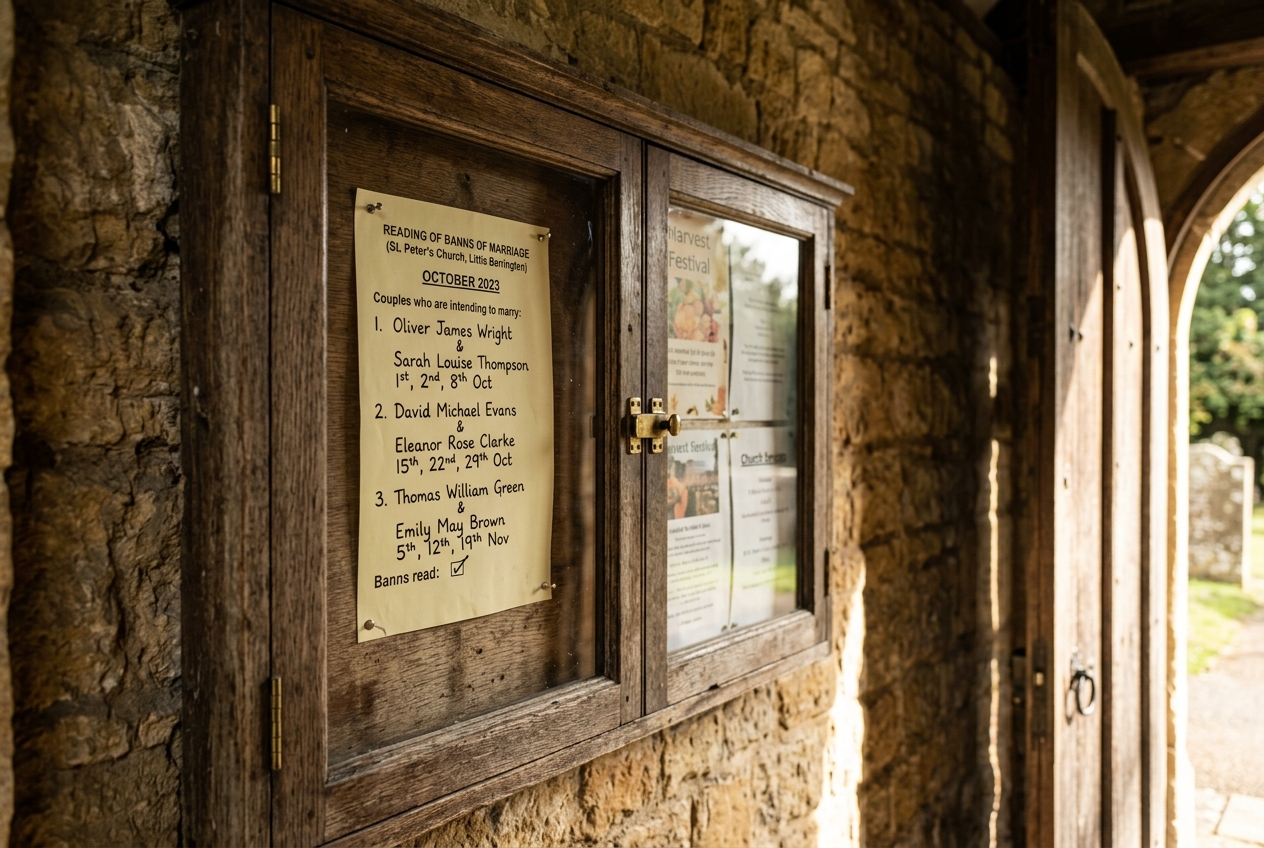
Banns are a legal requirement for Church of England weddings (unless you’re using a common licence or special licence instead). They’re a public announcement of your marriage, read aloud during Sunday services.
How it works:
- Banns are read at the church where you’re marrying
- If either partner lives in a different parish, banns must also be read at their parish church
- They’re read on three consecutive Sundays in the 3 months before the wedding
- Cost: ~£35 per church
You should attend at least one of the services where your banns are read — it’s considered good form, and you hear your names announced publicly.
Alternatives to banns
| Method | When Used | Cost |
|---|---|---|
| Banns (standard) | Most church weddings | ~£35 per church |
| Common licence | Short notice, or one partner lives abroad | ~£100-200 |
| Special licence | Marrying in a church you have no connection to | ~£200-400 (Archbishop’s licence) |
A common licence allows you to marry without banns — useful if you’re marrying at short notice (less than 3 months) or if one partner lives abroad. Apply through the diocesan registrar.
Costs
| Fee | Amount |
|---|---|
| Marriage service (statutory fee) | £500-550 |
| Banns (per church) | ~£35 |
| Marriage certificate | £11 |
| Organist | £100-200 |
| Bell ringing | £100-250 |
| Choir (if available) | £100-300 |
| Church heating (winter) | £50-100 |
| Verger/sexton | £30-60 |
| Total | £600-1,200 |
The statutory fee is set by the Church Commissioners and updated annually. It covers the vicar’s time, use of the church, and the marriage registration.
What the vicar will ask
- Who is walking the bride down the aisle?
- Will you have personal vows in addition to the set vows?
- How many readings? Who is reading?
- Which hymns? (Usually 2-3)
- Which entrance and exit music?
- Do you want bells?
- Will there be a choir?
- Are there any family situations they should be aware of (divorced parents, bereavements, sensitivities)?
The ceremony structure
A Church of England wedding service follows a set structure (from Common Worship):
| Order | Element |
|---|---|
| 1 | Entrance of the bride (processional hymn or music) |
| 2 | Welcome and introduction |
| 3 | Preface (“Dearly beloved…“) |
| 4 | The declarations (“Will you take…?“) |
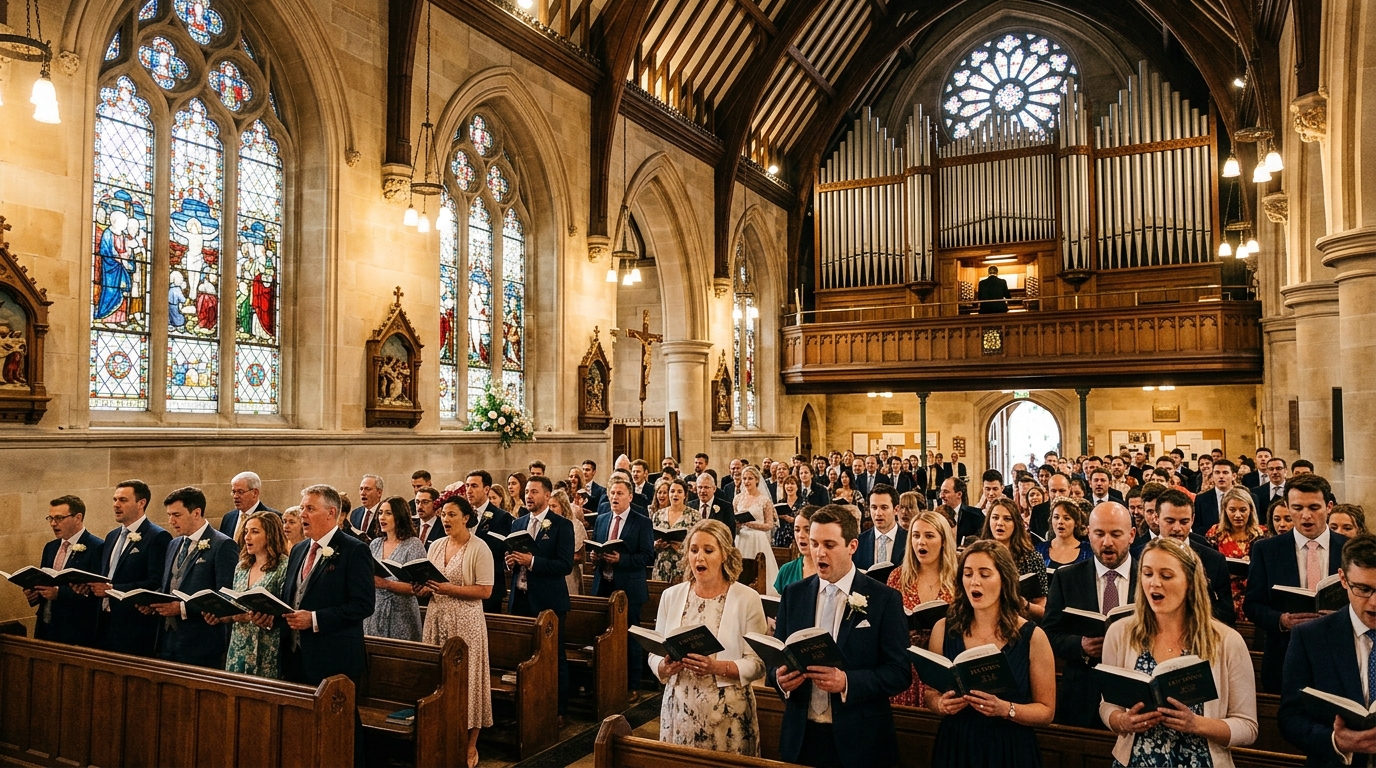
| 5 | Hymn |
| 6 | Reading(s) — usually 1-2 |
| 7 | Address/sermon by the vicar |
| 8 | The vows (“I, [name], take you, [name]…“) |
| 9 | Ring exchange and blessing |
| 10 | The proclamation (“I therefore proclaim that they are husband and wife”) |
| 11 | Prayers |
| 12 | Hymn |
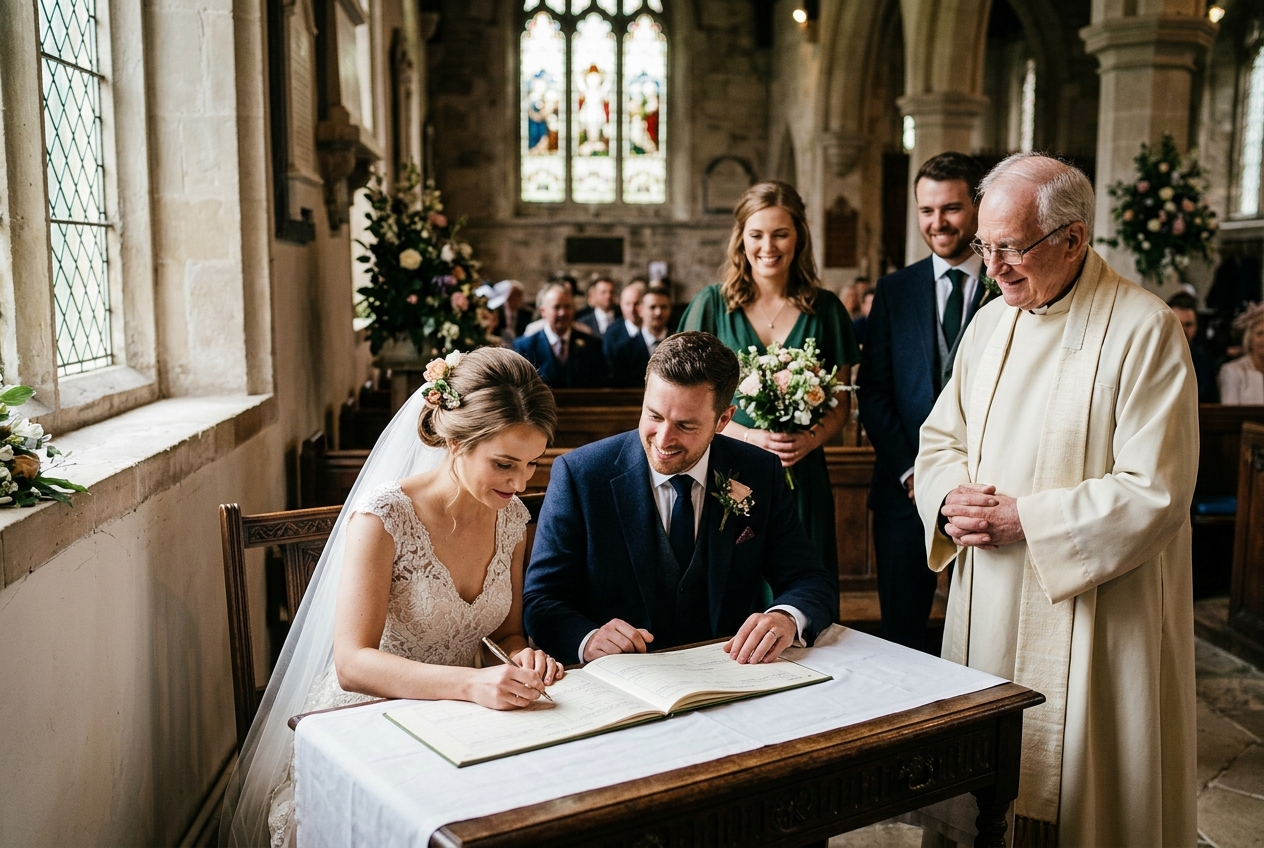
| 13 | Signing of the register (background music) |
| 14 | Recessional hymn or music |
Total time: 45-60 minutes.
Divorced partners
The Church of England allows the remarriage of divorced individuals, but individual vicars have discretion. Some will remarry divorced people without hesitation. Others will suggest a blessing after a civil ceremony instead.
If one or both partners are divorced:
- Discuss with the vicar early — before booking anything
- The vicar may ask to see the divorce decree absolute
- Some vicars require the bishop’s permission
- A service of blessing (after a civil ceremony) is always an option if the vicar declines to conduct a full marriage service
Catholic weddings (brief guide)
- At least one partner must be Catholic
- Marriage preparation course required (usually a weekend course: Marriage Care or similar)
- “Freedom to marry” certificate from your parish priest
- If one partner is not Catholic, a dispensation from the bishop is needed
- Nuptial Mass (with communion) or Marriage Service (without communion)
- Must take place in a Catholic church — not at an approved venue
Other denominations
Methodist: Similar to Church of England. Contact the minister to discuss requirements. More flexible on venue and service content.
Baptist: The church must be registered for marriages. Speak to the pastor.
Quaker: One of the simplest processes. Both partners must attend meeting for worship. No clergy needed — the couple marry each other.
Church of Scotland: Scottish law differs from English law. The minister handles all legal requirements. Humanist ceremonies are also legally recognised in Scotland.
Further reading
- Wedding Readings — poems and passages
- Wedding Hymns — choosing the right hymns
- Wedding Vows — personal vows alongside set vows
- Order of Service — what to print
- Registry Office Wedding Cost — the civil alternative
Frequently asked questions
Can anyone get married in a Church of England church?
You need a qualifying connection to the parish. The most common are: you live in the parish, you worship at the church regularly, a parent or grandparent was married there, or you were baptised there. If none of these apply, you can establish a connection by attending services for 6 months. Speak to the vicar — they're usually more flexible than you'd expect.
How much does a Church of England wedding cost?
The statutory fee for a Church of England wedding is approximately £500-550 (set by the Church Commissioners and updated annually). Additional costs: organist (£100-200), bells (£100-250), choir (£100-300), flowers (your florist), heating (£50-100 in winter). Total: £600-1,200 depending on extras.
What are banns of marriage?
Banns are a public announcement of your forthcoming marriage, read aloud during Sunday services for three consecutive Sundays before the wedding. They must be read at the church where you're marrying AND at any church in whose parish you live (if different). Banns cost approximately £35 per church. Arrange them 3-6 months before the wedding.
Do you have to be christened to marry in church?
No. Neither partner needs to be baptised (christened) to marry in a Church of England church. However, if either partner has been divorced, the vicar may require additional discussion and approval from the bishop. Some vicars will not remarry divorced individuals — this varies by parish.
Can you get married in a Catholic church in the UK?
Yes, but the requirements are different. At least one partner must be Catholic. You'll need to attend a marriage preparation course (usually a weekend), obtain a 'freedom to marry' certificate from your parish priest, and arrange paperwork through your local Catholic parish. Catholic weddings cannot take place at approved venues — only in a Catholic church.