Wedding Vows: How to Write Your Own
Key Takeaways
- Personal vows should be 1-2 minutes each (150-250 words) — any longer and the emotion dilutes
- The formula: what I love about you + a specific memory + what I promise + what the future looks like
- Write them separately but agree on length and tone beforehand — one funny and one sobbing doesn't work
- Practise aloud at least 5 times, but don't memorise — read from a card on the day
- You must still say the legal declarations required by law, even if you add personal vows
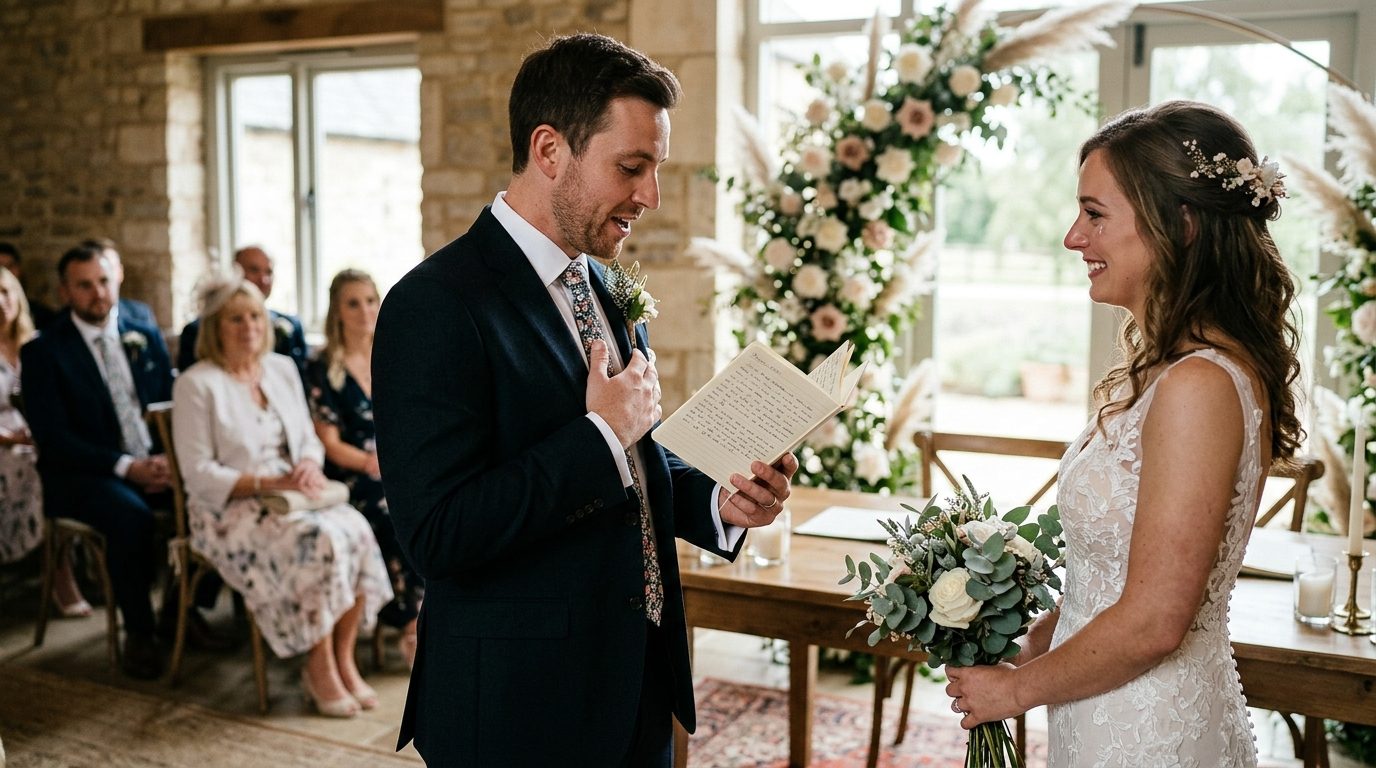
Personal wedding vows are the most intimate part of any ceremony. They’re the moment you speak directly to each other — not to the audience, not to the registrar, just to the person you’re marrying.
They’re also terrifying to write. This guide makes it manageable.
The legal requirements first
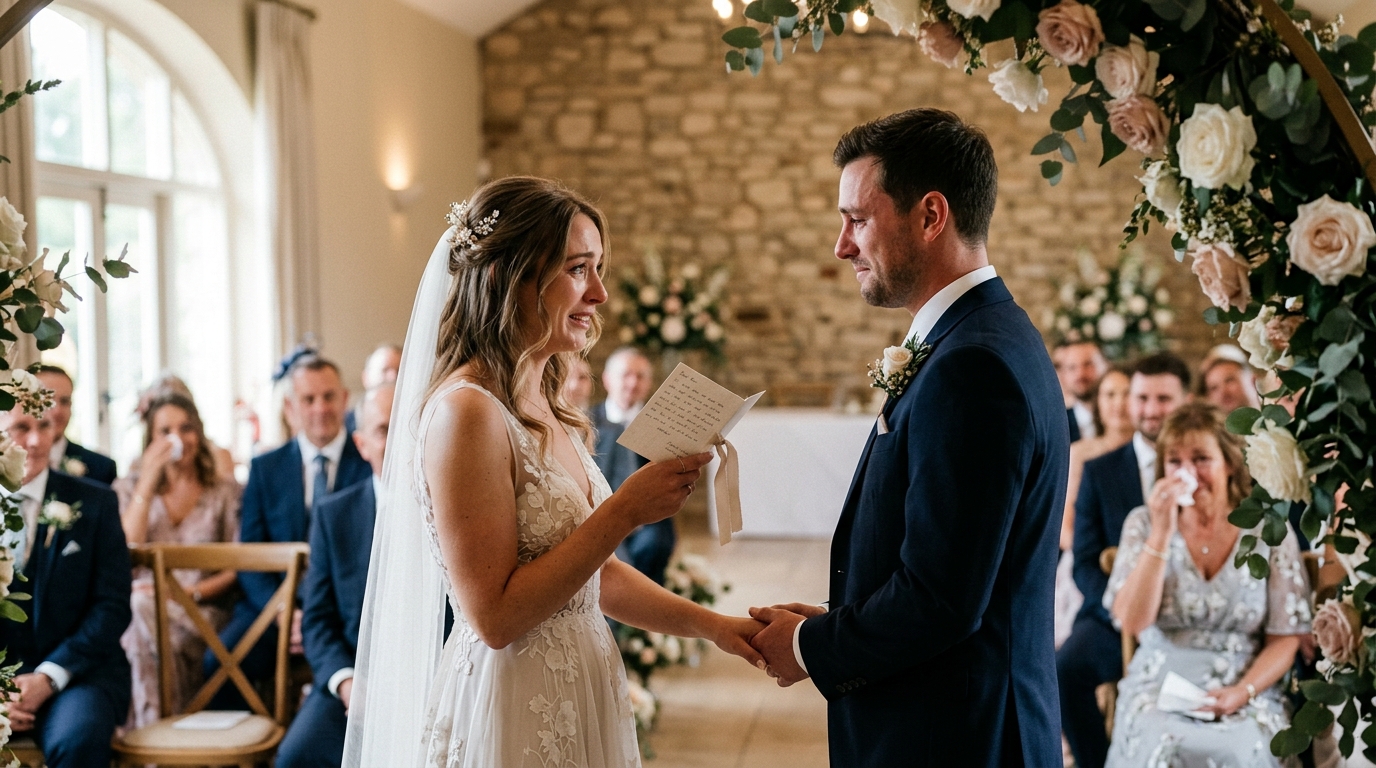
In the UK, you must say specific legal words during the ceremony regardless of whether you add personal vows.
England and Wales (civil ceremony): You must say: “I declare that I know of no legal reason why I may not be joined in marriage to [name]” and “I, [name], take you, [name], to be my wedded wife/husband/spouse.”
Your registrar will guide you through these on the day. Personal vows are said in addition to — not instead of — the legal declarations.
Church of England: Set vows are part of the service: “I, [name], take you, [name], to be my wife/husband. To have and to hold from this day forward; for better, for worse, for richer, for poorer, in sickness and in health, to love and to cherish, till death us do part.”
Some vicars allow personal additions before or after the set vows. Discuss with your officiant.
How to write personal vows
Step 1: Agree the parameters
Before writing separately, agree with your partner on:
- Length: Both the same (150-250 words each is ideal)
- Tone: Both funny? Both emotional? One of each? Match the energy
- Content: Will you share specific promises? Will you mention specific memories?
- Surprise or share? Most couples keep their vows secret until the ceremony, but some share to coordinate
Step 2: The formula
Every good personal vow covers four things:
- What I love about you (qualities, character, the specific things)
- A memory (a moment that captures who you are together)
- What I promise (specific, achievable commitments)
- What the future looks like (hope, excitement, a shared vision)
Step 3: Write the first draft
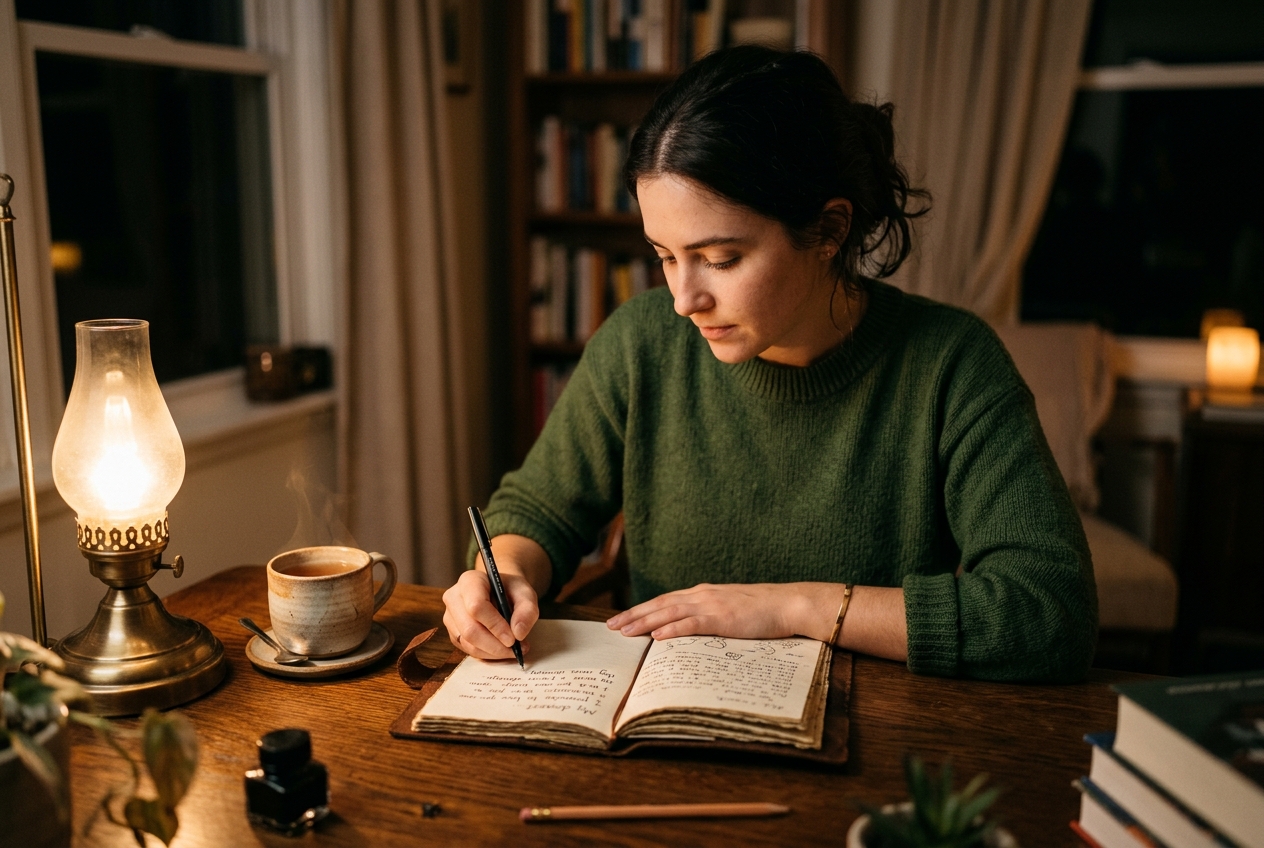
Set aside 30 minutes. No distractions. Write freely — don’t edit as you go. Answer these prompts:
- When did you know this was the real thing?
- What does your partner do that nobody else sees?
- What have they taught you?
- What’s one moment that changed your relationship?
- What do you promise for the future?
- What does your life look like together in 10 years?
Step 4: Edit to 200 words
Cut ruthlessly. Remove anything generic (“you’re my best friend” — show it, don’t state it). Remove anything that could apply to anyone. Keep only what is specific to your partner and your relationship.
Step 5: Practise aloud
Read your vows aloud at least 5 times. To yourself. Standing up. At speaking volume. Note where you get emotional — pause and breathe at those points.
Example personal vows
Heartfelt
“I fell in love with you in a supermarket car park at 9pm on a Tuesday. You were trying to fit a Christmas tree into a Fiat 500 and losing badly. I offered to help. You said, ‘I’ve got this,’ and proceeded to break the wing mirror. I knew right then.
You make me braver. You make me kinder. You make me eat vegetables. I promise to always hold your hand when you’re scared, to always laugh at your jokes even when they’re terrible, and to never, ever mention the wing mirror again. I love you.”
Funny with heart
“I promise to let you have the last roast potato. I promise to pretend I don’t notice when you cry at dog videos. I promise to always check behind the shower curtain for intruders when you ask me to — even though there has never once been an intruder.
But I also promise to be honest with you, to choose you every day, and to build a life with you that we’re both proud of. You are my favourite person, and I am ridiculously lucky.”
Short and sincere
“You are home. Wherever we are, whatever happens, you are where I belong. I choose you today, and I will choose you every day after this. I love you.”
What NOT to include
- Exes. Not even to say your partner is better than them
- Private jokes that only you two understand — the audience is listening too
- Apologies. “I know I’m not perfect” — this isn’t the moment for self-criticism
- Conditions. “As long as you…” — vows are unconditional
- Other people’s words. Write your own, even if they’re imperfect. A quote from Google is not a personal vow
- Overly long lists. Three promises are memorable. Fifteen are a shopping list
Delivery tips
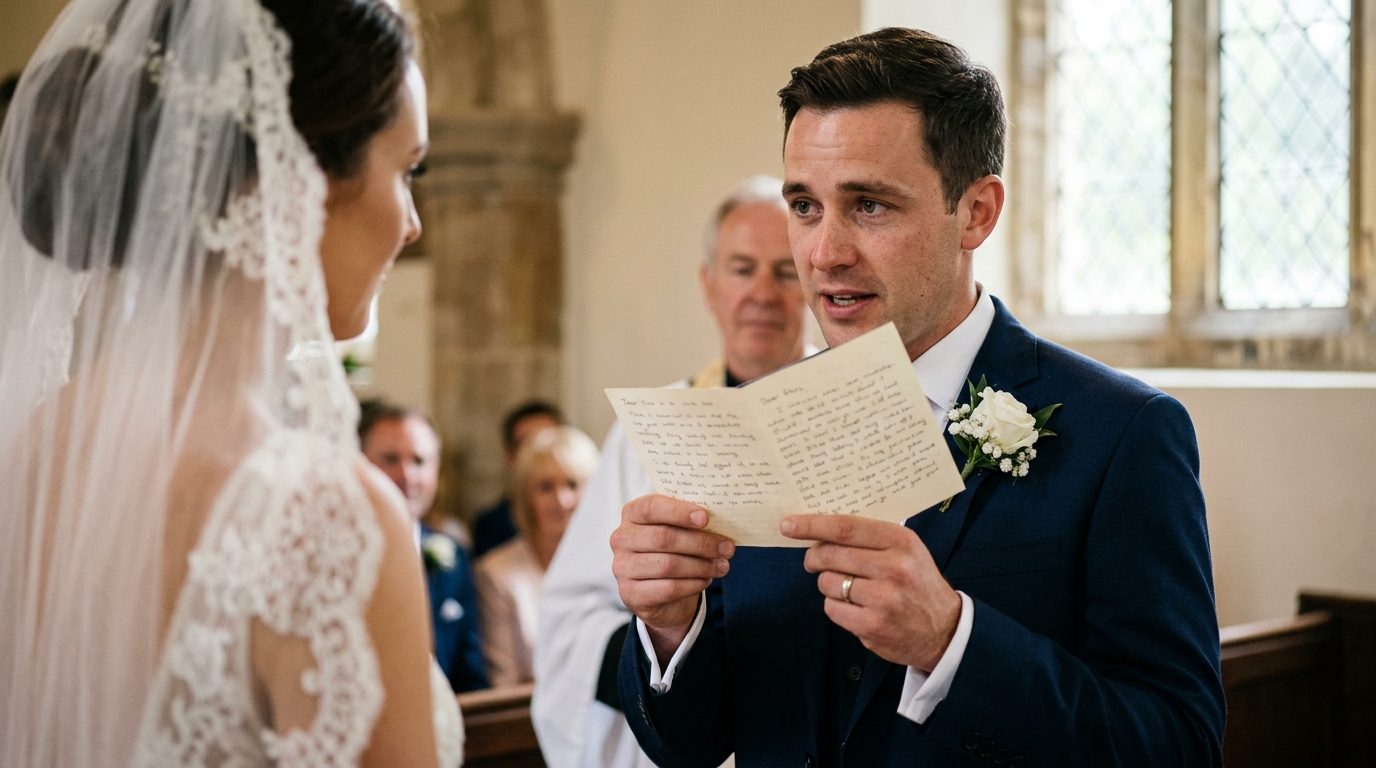
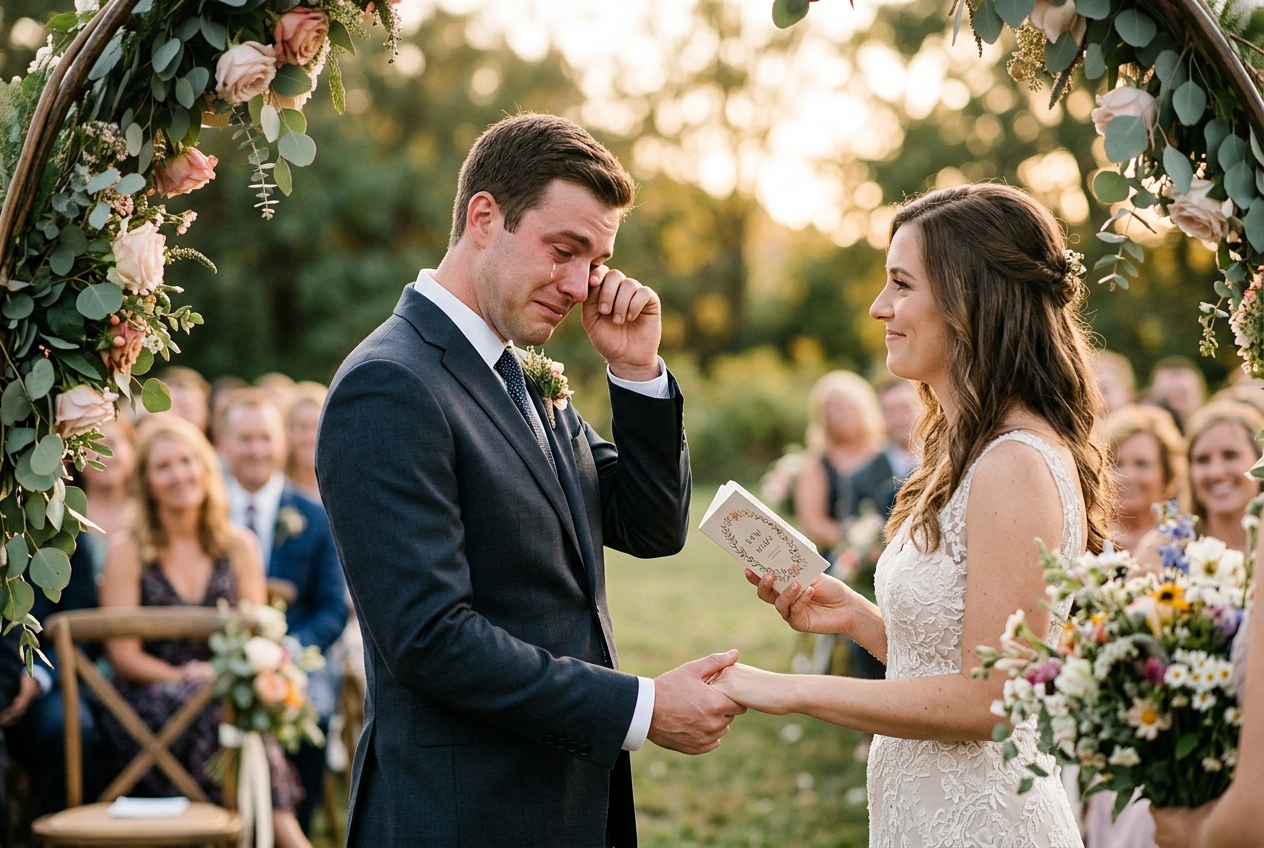
- Read from a card. Small, thick card in large handwriting. Not your phone. Not a scroll
- Look up. After each sentence, look at your partner. The audience watches the reaction
- Speak slowly. Emotion accelerates you. Consciously slow down
- Pause if you cry. It’s expected. Take a breath, smile, continue. The audience will wait
- Hand the card to your best man/maid of honour before the ring exchange so your hands are free
Further reading
- Wedding Readings — poems and passages for the ceremony
- Order of Service — where vows fit in the running order
- Church Wedding Requirements — vow rules for church ceremonies
- Wedding Day Timeline — the day-of schedule
Frequently asked questions
Do you have to write your own wedding vows in the UK?
No. Traditional vows are provided as part of the ceremony — you simply repeat them. Personal vows are optional additions that come alongside (not instead of) the legal declarations. In England and Wales, the registrar will tell you the required legal words. In the Church of England, the set vows are part of the liturgy.
How long should personal wedding vows be?
1-2 minutes each (150-250 words). This is enough for something meaningful without losing the audience. Both partners should agree on a rough length beforehand — one speaking for 30 seconds and the other for 5 minutes creates an awkward imbalance.
What are the legal vows required in the UK?
In England and Wales, both partners must make a declaratory statement ('I declare that I know of no legal reason why I may not be joined in marriage to [name]') and a contracting statement ('I, [name], take you, [name], to be my wedded wife/husband/spouse'). These exact words (or approved variants) are legally required.
Should we read our vows or memorise them?
Read from a card. Memorising creates enormous pressure, and forgetting a line mid-ceremony is devastating. Write your vows on a small card, practise until you know them well (so you look up frequently), but read from the card. Nobody judges you for it — it shows you put thought into the words.