Home / Articles / Wedding Trends
Gen Z Now Outnumber Millennial Brides: 5 Changes
Key Takeaways
- Gen Z couples marry later than their parents but earlier than millennials did at the same age — average 28.4 for Gen Z women vs 30.1 for millennials at point of booking
- 67% of Gen Z UK couples research suppliers exclusively on TikTok and Instagram before contacting anyone
- Gen Z weddings average 68 guests — smaller than the millennial average of 88
- Gen Z are 3x more likely than millennials to request a no-phone ceremony policy
- Micro-wedding and elopement bookings have risen 41% in two years, driven almost entirely by Gen Z
Who counts as Gen Z in the wedding market?
Gen Z is typically defined as those born 1997-2012. In 2026, that makes the oldest Gen Z’ers 29 and the youngest 14. The wedding-active cohort is those aged 22-29 — born roughly 1997-2004.
This cohort grew up with smartphones in their hands from secondary school. They came of age during a cost-of-living crisis. They watched their millennial older siblings and cousins take on mortgage debt and host large traditional weddings — and many of them have consciously chosen a different path.
They are also the generation most shaped by the pandemic: many were 17-23 during COVID lockdowns, and their first experiences of adulthood included cancelled gatherings, digital social lives, and an intense focus on who and what actually mattered.
That context shapes how they approach a wedding. It is not primarily a social performance or a family milestone. It is a deliberate choice, shared with the people they genuinely want there.
The ONS age data: Gen Z marrying younger than expected
ONS marriage statistics show the average age of marriage for women in England and Wales rose steadily from 26.6 in 2000 to 31.2 in 2019. The pandemic interrupted the trend, but the post-pandemic data shows something unexpected: the age for first marriages among women under 30 is recovering faster than for women over 35.
The reason is not a return to traditional values. It is economic pragmatism. Gen Z couples recognise that property is increasingly out of reach. A wedding, scaled to what they actually want, is achievable. Delaying it for an indefinite future when they can afford a house is not a trade-off they are willing to make.
Change 1: smaller guest lists, higher spend-per-head
The reduction is not primarily about budget. It is about intention. Gen Z couples are more likely to describe their wedding guest list as “people we actually talk to regularly” rather than “family obligations and work colleagues.” Several Gen Z couples we spoke with described cutting second-tier relationships — distant relatives, old school friends they no longer see — specifically to keep the day feeling real.
The consequence is a higher spend-per-head even among couples spending less overall. A £18,200 wedding for 68 guests is £268 per head — close to the national average of £272. The reduction in guest count has not translated into lower per-person investment. Gen Z couples are spending less in total but not skimping on the experience they are creating for the people they do invite.
For venues and caterers, this is a structural shift. A Gen Z couple booking your 80-seat venue may fill it with 65-70 guests rather than 90. Minimum spend thresholds and per-head minimums need to account for this.
Change 2: TikTok is the first touchpoint, not Google

 This is a complete inversion of the millennial sourcing pattern. Millennial couples in 2016-2022 overwhelmingly used Google, then directory listings, then social media to confirm they liked what they found. Gen Z start with video content, then go to the website if the content convinces them.
The implications for suppliers:
- A venue or photographer with no short-form video content is effectively invisible to more than half the new wedding market.
- Reviews on Google and Trustpilot matter less to Gen Z than the quality and authenticity of video content.
- The supplier they book is often the one whose content they have been watching for months — not the one who comes up first in a search.
Change 3: no-phone ceremonies are becoming standard
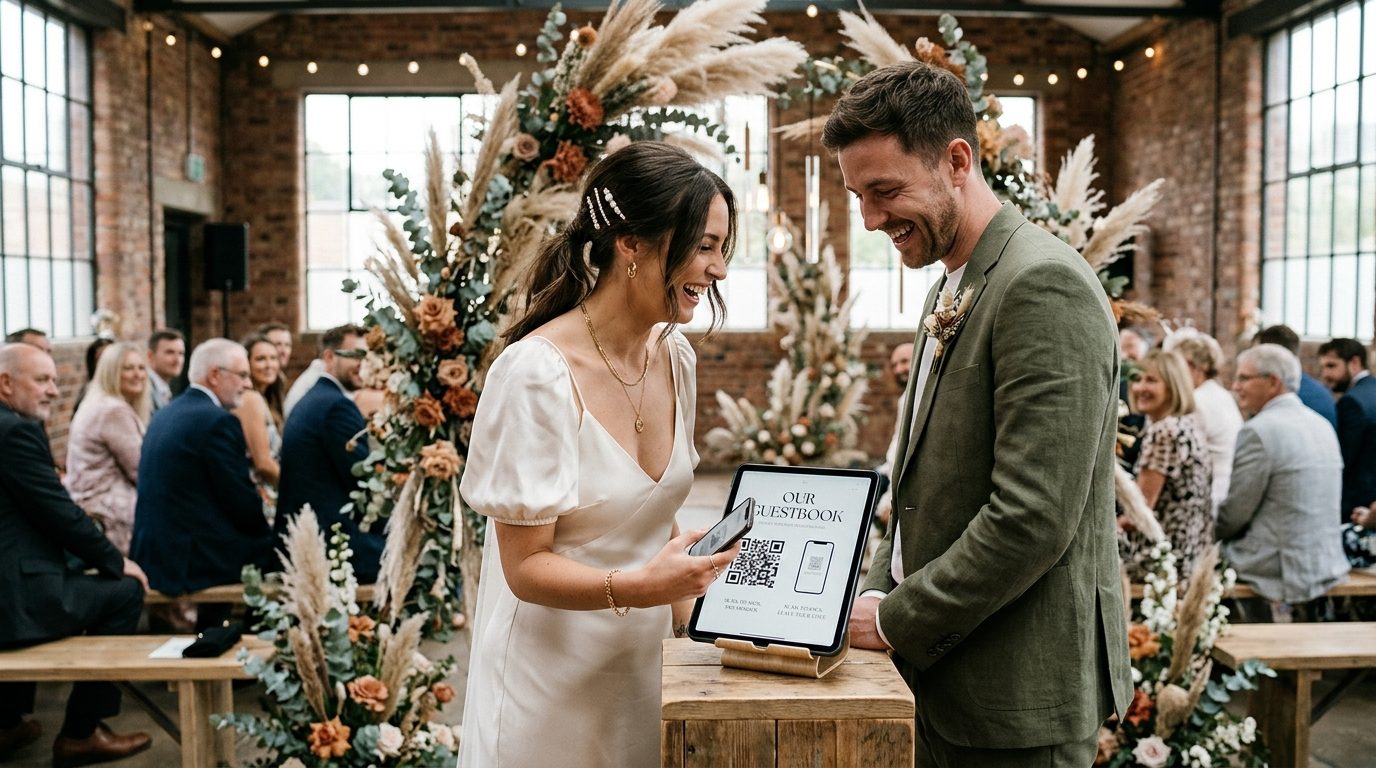
18% of all Gen Z bookings in 2026 included an explicit no-phone ceremony request in the venue enquiry, versus 6% of millennial bookings. Some Gen Z couples are extending the policy to the entire reception.
The motivation is primarily aesthetic and emotional: Gen Z couples report wanting guests to be present, not curating content. Several have also cited the experience of attending digitally-documented weddings where the guests holding up phones blocked sightlines and created a barrier between the couple and the people they most wanted to see.
The secondary motivation is control over their own narrative. Gen Z understands social media. They know that unfiltered guest photos — bad angles, poor lighting, unflattering moments — will circulate. They prefer to give their professional photographer time to work, then share a curated set of images on their own timeline.
For more on how couples are managing this, see unplugged wedding ceremonies: the 91% approval rule.
Change 4: the dry wedding shift
18% of Gen Z couples planning UK weddings in 2026 are opting for fully dry or low-alcohol events. That compares to 6% of millennial couples planning in the same period.
This is not primarily driven by religion or personal sobriety, though both are factors. Gen Z’s relationship with alcohol is structurally different from previous generations. The Office for National Statistics has recorded declining alcohol consumption among 16-24 year olds for a decade. Gen Z are more likely to be sober-curious, more likely to have a significant number of non-drinking friends, and more likely to frame alcohol as a default they should opt into rather than a default they should opt out of.
The consequences for wedding planning are practical. Zero-proof bars are no longer unusual at Gen Z weddings — they are expected. The mocktail bars at UK weddings guide covers the suppliers and the cost differential (typically 15-20% lower bar spend on a dry or semi-dry format).
Change 5: traditions are optional, aesthetics are not
- 72% are skipping the garter toss
- 61% are not providing wedding favours
- 54% are skipping the bouquet throw
- 38% are replacing formal sit-down dinners with food stations or tasting menus
What Gen Z couples are not skipping: photography, music, and aesthetic moments. These three categories see no reduction in Gen Z spend. A Gen Z couple cutting favours and a formal dinner will reallocate that budget to a photographer they have followed on Instagram for two years and a florist whose work they have saved on Pinterest for three months.
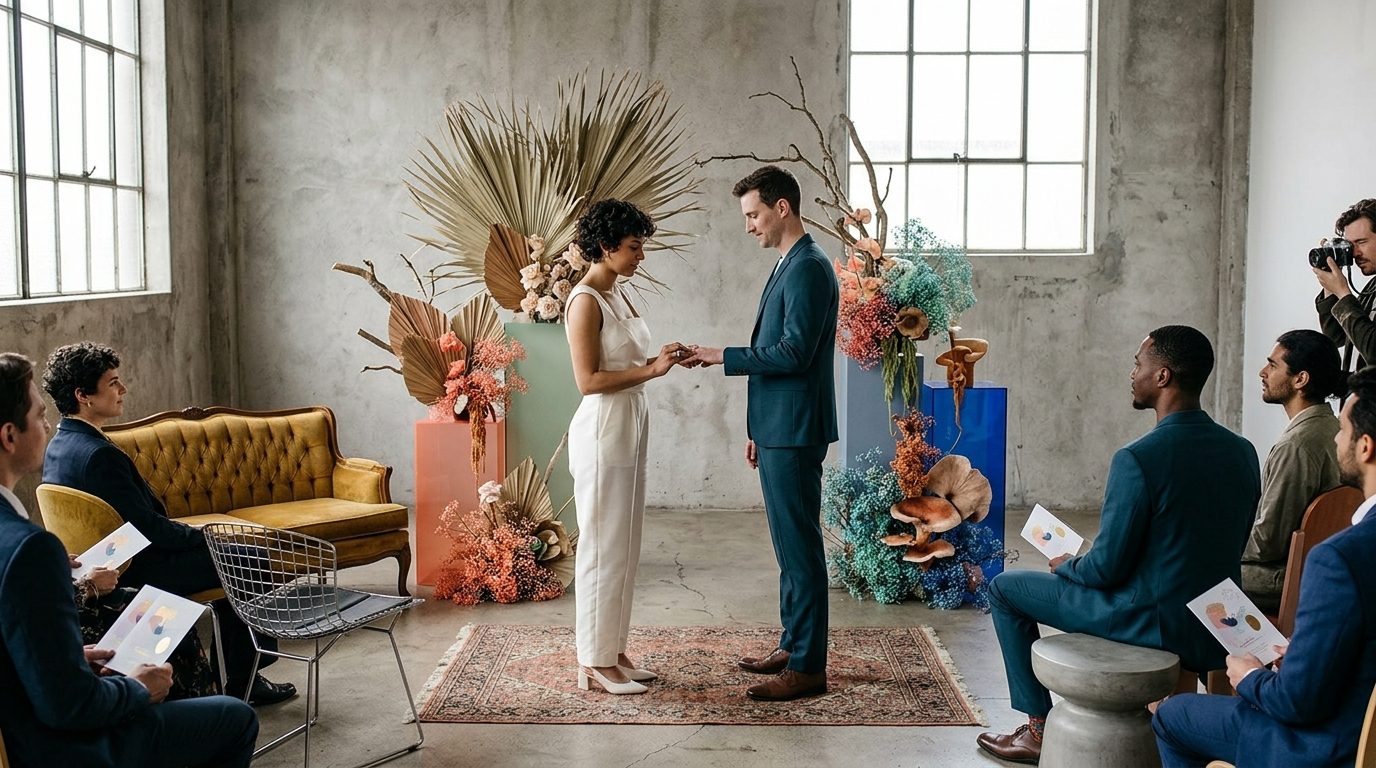
The aesthetic priority manifests in ways that change supplier requirements. Gen Z couples often have a more specific, reference-rich brief than millennial couples. They arrive at consultations with hundreds of saved images, a defined palette, and a clear sense of what they do not want. Suppliers who can engage with a precise aesthetic brief — and who present their portfolio in a visually coherent, platform-native way — are the ones winning Gen Z bookings.
What this means for the UK wedding industry
The shift from millennial to Gen Z dominance is not a crisis for the industry. Gen Z couples spend less in total but at a similar per-head rate. They are more intentional buyers, harder to reach through traditional channels, and more likely to book the supplier whose content they have trusted over months.
The suppliers who adapt to this will capture a growing share of a market that continues to recover from the 2020-2022 backlog. Those who rely on Google rankings, directory listings, and word-of-mouth alone will find their enquiry volume declining — not because weddings are falling off, but because the cohort doing the research has changed the research process.
Gen Z weddings are smaller, drier, more intentional, and more aesthetically focused than their predecessors. The couples are younger than the trend predicted, less debt-averse than expected, and more willing to spend seriously on the things they care about.
Frequently asked questions
Do Gen Z couples spend more or less on weddings than millennials?
Gen Z UK couples currently spend an average of £18,200 — below the national average of £21,990 (Hitched 2026). They prioritise food, photography, and music, and cut budget on traditional extras like wedding favours, printed stationery, and formal floral arrangements.
What do Gen Z brides want that millennials didn't?
Gen Z prioritise: no-phone ceremonies, digital invitations, micro-weddings with close guests only, diverse supplier teams, and social-media-ready aesthetic moments. They are also more likely to forgo traditions like garter tosses and bouquet throws.
Are Gen Z weddings smaller than millennial weddings?
Yes. The shift reflects a broader Gen Z preference for intimate experiences over large-scale events.
How does Gen Z find wedding suppliers?
67% of Gen Z couples report using TikTok or Instagram as their primary supplier research tool, before visiting any directory or search engine. Suppliers without a strong short-form video presence are effectively invisible to this cohort.
Are Gen Z couples more likely to have a dry wedding?
Significantly more likely. The zero-proof trend is predominantly a Gen Z phenomenon.
What wedding traditions are Gen Z dropping?
The most commonly dropped traditions among Gen Z couples: the garter toss (72% skipping it), bouquet throw (54%), wedding favours (61%), and formal sit-down dinner structure (38% opting for food stations or tasting menus instead).
Which UK regions have the highest Gen Z wedding share?
Gen Z weddings are most concentrated in major urban centres: London, Manchester, Birmingham, Bristol, and Leeds. Rural and coastal venues still see a predominantly millennial and older client base.