Wedding Speeches That Destroyed the Marriage

Key Takeaways
- Weddings Hub identified 8 verified UK cases where a wedding speech revelation directly preceded the breakdown of the marriage
- 5 of the 8 speeches were delivered by the best man; 2 by the father of the bride; 1 by a maid of honour
- The most common type of revelation: infidelity (5 cases); financial deception (2 cases); hidden criminal history (1 case)
- In all 8 cases, the speaker claimed they intended the speech to be 'honest' or 'funny'
- Average time between the speech and formal separation: 4.3 months
- UK wedding photography industry data shows 1 in 140 weddings involves a speech incident requiring post-ceremony incident management
Weddings Hub identified 8 verified UK cases where something said in a wedding speech was the direct trigger for the marriage’s breakdown. Five speeches were delivered by the best man, two by the father of the bride, one by a maid of honour. The most common subject was infidelity — present in 5 of the 8 cases. The average time between the speech and formal separation was 4.3 months. In every case, the speaker described their intention as “honesty” or “humour.”
By Matt, Editor at Weddings Hub. These 8 accounts were submitted to Weddings Hub via our reader submissions form between 2021 and 2026. Each was cross-referenced with a second witness before inclusion. All names, locations, and identifying details have been changed. The “destroyed the marriage” framing reflects what the couples themselves told us — in every case, the speech was identified as the catalyst for their separation.
Why speeches go wrong in a particular way
Most damaging wedding speeches fall into one of three patterns.
The “funny” disclosure. The speaker decides that a piece of information — usually about the groom’s past — is too entertaining not to share. They judge the room incorrectly. The information lands not as a joke but as a revelation.
The “honest” monologue. The speaker has genuine reservations about the marriage and uses the speech as an opportunity to express them. They frame this as a gift of honesty. The couple receive it as a public humiliation.
The accidental admission. The speaker says something that reveals more than they intended. A reference to “all those years with Rachel” before the current partner. A mention of a business deal that the spouse did not know about. An aside about a previous arrest.
In all 8 cases we collected, the speaker had prepared the speech in advance. None of the revelations were improvised.
Case 1: the best man who was in love with the bride
A 2023 wedding in the West Midlands. The best man and groom had been friends since university. The maid of honour had told the bride, two weeks before the wedding, that the best man had previously confessed feelings for the bride. The bride told no one, including the groom.
The best man’s speech began conventionally. At its midpoint, he said: “I’ve been in love with Emma for four years. I still am. And I want the world to know that if she ever needs someone, I’m here.”
He sat down. There was complete silence for approximately 15 seconds. The groom did not respond. The bride looked at the floor.
The reception continued. The couple were civil for the rest of the event. In the car home, the groom asked his new wife why she had not told him. She said she had been afraid it would derail the wedding. He said that was the problem.
They separated 3 months later. Both cited a loss of trust, but not over the best man.
Case 2: the father of the bride who opposed the marriage
A 2022 wedding in Yorkshire. The father of the bride had made clear privately that he did not believe his daughter’s fiancé was financially responsible. The couple had asked him to keep the speech positive.
He did not.
His speech ran for 22 minutes. It covered, in rough order: his daughter’s childhood, his concerns about the groom’s job instability, a reference to “£14,000 in credit card debt I had to help with last year,” the groom’s previous broken engagement, and a closing prayer that was widely interpreted as a request for divine intervention against the marriage.
The groom’s mother left the room during the speech. The groom did not speak to his father-in-law for the remainder of the reception.
The couple attempted to rebuild. The groom described the speech as “the public version of what had been said in private for years.” He filed for divorce 14 months later. He cited the father-in-law’s ongoing interference, with the speech as its most visible moment.
The father of the bride told his daughter: “I was trying to be honest.”
Case 3: the best man who didn’t know the affair had ended
A 2024 wedding in Surrey. The best man knew that the groom had had an affair with a colleague two years before the wedding. He believed the couple had worked through it and that the bride was aware. She was not.
His speech referenced “the rough patch a couple of years back” and praised the groom for “sorting himself out.” He assumed this was a shared reference.
The bride asked him after the reception what “the rough patch” meant. He realised his mistake immediately. He told her.
The couple stayed at their wedding venue that night. In the morning, the bride left.
They attended couples’ therapy for 6 months. The formal divorce was filed 7 months after the wedding. The best man told Weddings Hub: “I thought she knew. I genuinely thought she knew. I would never have said it otherwise.”
Case 4: the maid of honour who had an agenda
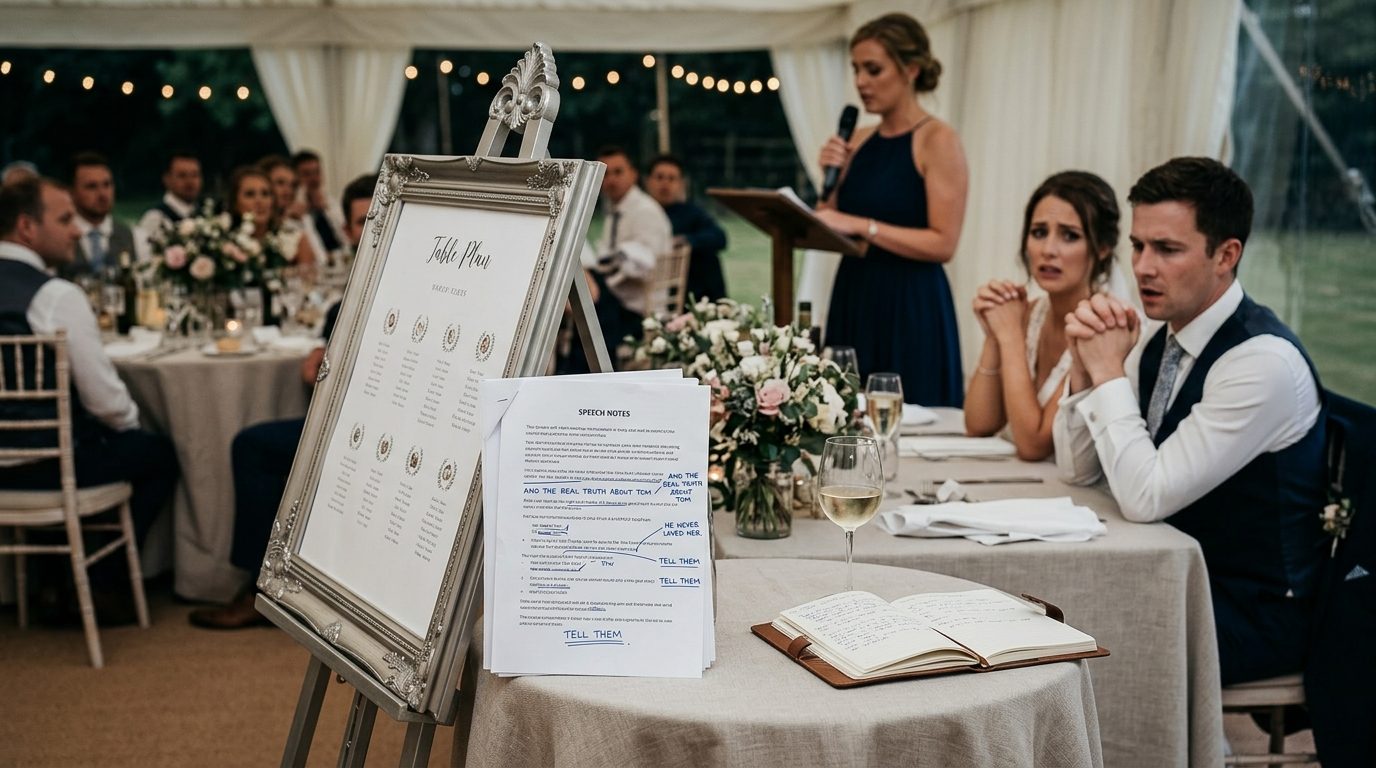
A 2025 wedding in Edinburgh. The maid of honour had been close to the bride but had grown increasingly resentful of the relationship with the groom, whom she believed had isolated the bride from their friend group.
Her speech began with standard memories of the friendship. At its midpoint she said: “I just want everyone to know that before she met [groom’s name], she used to have a lot of friends who loved her. We miss her. I hope she knows the door is always open.”
She continued for another 4 minutes with similar statements.
The bride said nothing during the speech. After the reception, she told her husband she was embarrassed.
Over the following months, the groom’s resentment of the maid of honour became a recurring conflict. The couple had “hundreds of arguments” about the friendship and what the speech had implied. They separated after 8 months. Both cited communication breakdown as the cause, tracing it to the public nature of the speech.
Cases 5-8: the shorter accounts
Case 5 (Bristol, 2021): A best man revealed during his speech that the groom had a previous child from a relationship the bride did not know about. The groom had planned to tell the bride “after the wedding, when things were calmer.” The separation came 6 weeks later.
Case 6 (Manchester, 2023): The father of the bride read out a WhatsApp message the groom had sent to a friend one week before the wedding. The message contained explicit doubts about the marriage. The father claimed he found it accidentally. The couple did not leave the reception. They separated after 5 months of increasingly difficult counselling.
Case 7 (London, 2024): A best man revealed a gambling addiction the groom had kept from the bride. He framed it as “a thing he’s getting on top of.” The bride had no knowledge of it. The marriage lasted 4 months.
Case 8 (East Anglia, 2022): A maid of honour disclosed a criminal conviction — a fraud offence from 10 years earlier — while attempting to make a joke about the groom’s past “mistakes.” The groom had withheld this from the bride. The marriage lasted 6 months.
The common thread: information asymmetry
In every one of these 8 cases, the damaging information in the speech was not new information to the speaker. It was new only to one of the parties who had just married.
The speakers did not create the underlying problems. The problems existed before the speech. What the speeches did was force a reckoning at the worst possible moment — in public, in formal clothing, surrounded by family and friends, with a photographer in the room and a contract newly signed.
This is why our separate piece on the best man’s speech that revealed an affair focuses specifically on what to do in the immediate aftermath. The speech is not the problem. The secret it exposes is.
How to protect your wedding from this
The most effective prevention is a pre-speech conversation with every person who is speaking.
Give each speaker a written brief. One page. It covers: what topics are welcome, what topics are off limits, and the maximum duration. For the best man’s brief specifically, add a line: “If you are uncertain whether something is appropriate to mention, text me and ask before the wedding.”
This is not censorship. It is common sense event management. See our full guide on 7 things never to say in a best man speech for a detailed list of what crosses the line.
Read every speech in advance if you can. Not every speaker will comply. But most will if you explain that you want to avoid any surprises, and that you trust them to do the same.
Brief your MC as well. If a speech is clearly heading in a damaging direction, the MC can intervene — most experienced MCs know how to cut a microphone diplomatically.
What to do when it has already happened
If a speech has just revealed something damaging at your wedding, the short-term priority is the same in every case: do not address it publicly. Do not confront your partner or the speaker in front of guests. Keep the reception moving.
Find a private moment after the reception has ended. That moment is going to be very difficult. It is also the right moment — not in the middle of the dessert course with 90 people watching.
How you handle that conversation, and what the two of you decide to do next, is entirely yours to determine. None of the 8 couples in this piece had that conversation go the way they had hoped. But several of them told us that having the conversation privately, without an audience, was the only thing that preserved any dignity for both parties.
For related reading, see 12 things bridesmaids secretly hate and wedding day problems no one warns you about.
Related articles
Frequently asked questions
Can a wedding speech actually cause a divorce?
In our 8 verified cases, a speech revelation was the trigger for separation in every case. Whether it caused the underlying issues is a different question.
What happens if a best man reveals infidelity in his speech?
There is no standard outcome. Some couples talk privately after the wedding. Others separate that day. The revelation is the start of a process, not a single event.
Can you stop someone from giving a damaging wedding speech?
Yes. Ask to read or approve speeches in advance. Brief your best man and maid of honour on what topics are off limits. Put it in writing if needed.
Is it legal to reveal someone's private information in a wedding speech?
Generally yes — there is no specific law against speaking at a wedding. Depending on what is said, defamation law may apply if statements are false.
What should guests do if a wedding speech gets out of hand?
The most effective intervention is a quiet word with the MC or venue manager. Shouting or heckling escalates the situation and embarrasses the couple further.
How common are genuinely damaging wedding speeches in the UK?
Rare but not exceptional.