How to Write a Wedding Speech: Full Guide
Key Takeaways
- Start with one specific story — not a timeline of events — and build the speech around it
- Write the full speech first, then cut it to 5-7 minutes (700-1,000 words spoken aloud)
- The formula works for any speaker: opening, stories, emotional turn, sincere ending, toast
- Practice out loud at least 5 times — it should feel natural, not memorised
- Use cue cards on the day, not a full script or phone — eye contact is everything
Writing a wedding speech is simple. Writing a good one takes thought. The difference between a forgettable speech and one that people talk about for years is specificity — real stories, genuine emotion, and words that sound like they came from you, not a template.
This guide works for any speaker: best man, maid of honour, father of the bride, groom, bride, mother, or anyone else.
Step 1: Brainstorm stories
Before you write a single word of the speech, list 5-10 specific memories, moments, or stories involving the person (or couple) you’re speaking about.

Good stories are:
- Specific (a particular day, place, and what happened)
- Revealing (they show character, not just events)
- Appropriate (you’d be comfortable if the person’s grandmother heard it)
- Relatable (the audience doesn’t need inside knowledge to understand)
Bad stories are:
- Generic (“he’s always been a great guy”)
- Only funny to 3 people in the room
- About exes, stag/hen dos, or anything the couple doesn’t want public
- Long and meandering with no punchline or emotional payoff
Pick 2-3 stories. That’s all you need.
Step 2: Choose a structure
Every great wedding speech follows this arc:
The universal speech structure
| Section | Duration | Purpose |
|---|---|---|
| Opening | 15-30 seconds | Who you are, how you know the couple, set the tone |
| Story 1 | 1-2 minutes | Funny or light — warm the audience up |
| Story 2 | 1-2 minutes | Deeper — reveal character, show why they’re special |
| The turn | 30-60 seconds | Pivot from light to sincere |
| Sincere ending | 30-60 seconds | What they mean to you, a wish for their future |
| Toast | 15 seconds | Clear, confident, everyone knows to raise their glass |
Total: 4-7 minutes.
The “turn” is the most important transition. It’s the moment you shift from entertaining to moving. A good turn feels natural — it’s not “but on a serious note…” (which sounds scripted). It’s more like: the last story leads naturally into why you admire this person, which leads into your wish for their future.
Step 3: Write the first draft
Write the full speech in one sitting. Don’t edit as you go. Get everything on paper, then refine.
Write like you talk. Read each sentence aloud. If it sounds like a greeting card or a corporate presentation, rewrite it in your own voice.
Be specific. “She’s always been kind” is generic. “When I lost my job, she drove two hours on a Tuesday to sit in my kitchen and eat terrible wine” is specific. The specific version wins every time.
Write more than you need. Your first draft will be 8-10 minutes. That’s fine. It’s easier to cut a long speech than to pad a short one.
Step 4: Edit ruthlessly
Now cut it to 5-7 minutes. Remove:
- Anything generic. If you could say it about anyone, cut it.
- The second-best story. If you have 3 stories and one is weaker, it goes.
- Throat-clearing openings. “Firstly, I’d like to say what an honour it is…” — cut. Start with something interesting.
- Repeated thank-yous. Thank each person once, warmly, and move on.
- Quotes from the internet. If you Googled it, the audience has heard it.
- Inside jokes. If fewer than 80% of the room will get it, cut it.
The speech should feel too short. If you think “I could say more,” it’s the right length. If you think “this covers everything,” it’s too long.
Step 5: Create cue cards
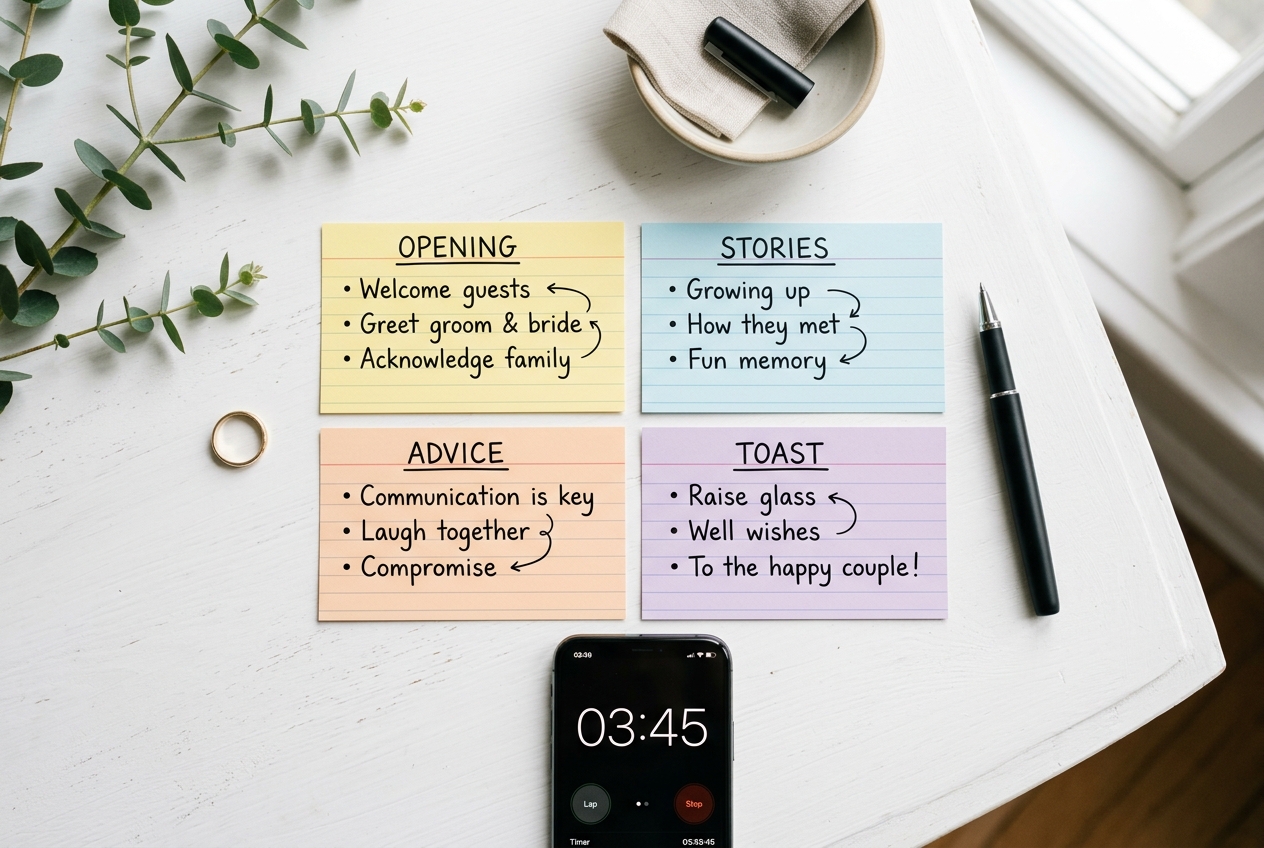
Don’t bring the full script on the day. Reduce the speech to 5-6 cue cards with bullet points.
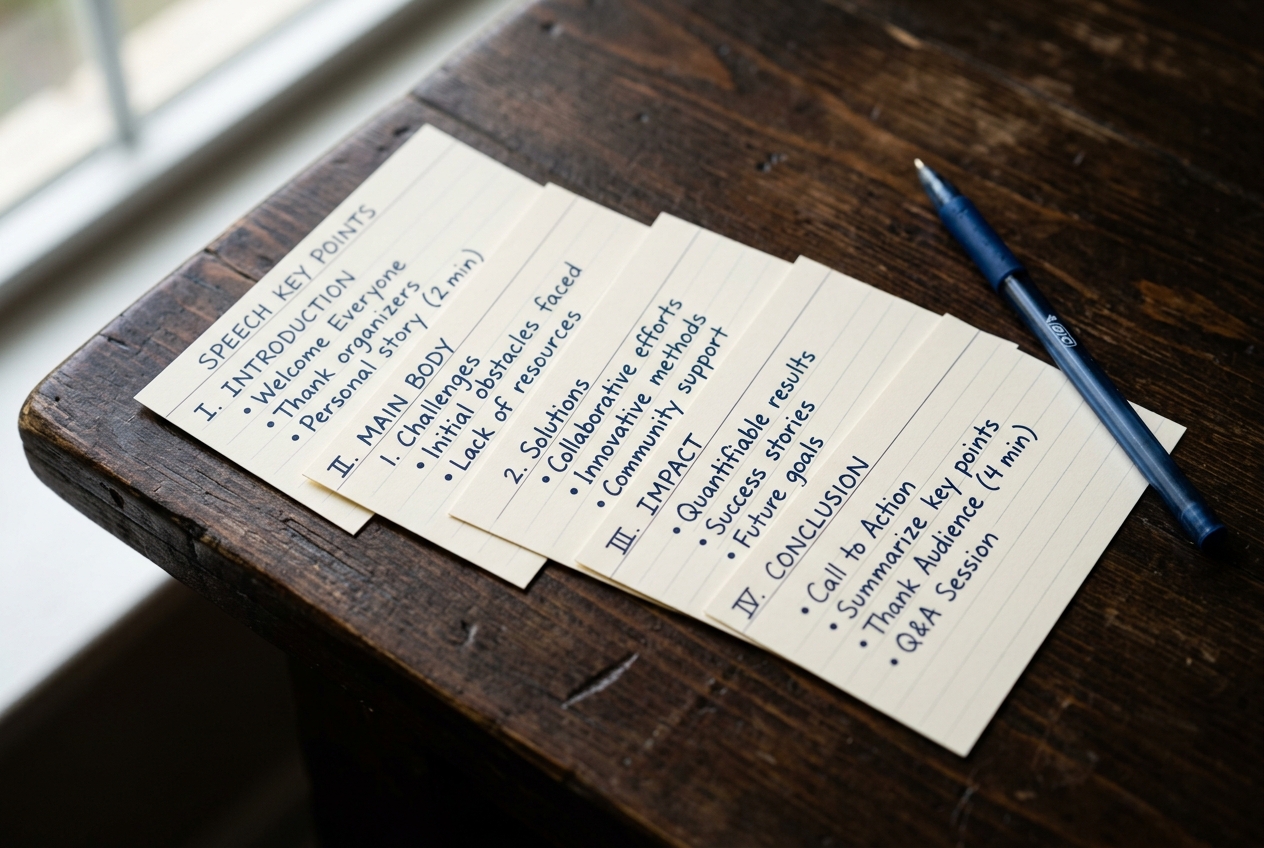
Each card should have:
- 3-5 bullet points (key words, not full sentences)
- The first line of each story (to trigger your memory)
- Transition phrases between sections
- The closing toast written in full (so you land it perfectly)
Number your cards in case you drop them. Use thick card stock that won’t shake visibly if your hands tremble.
Step 6: Practice
Practice out loud. Not in your head — out loud, standing up, at speaking volume. This is non-negotiable.
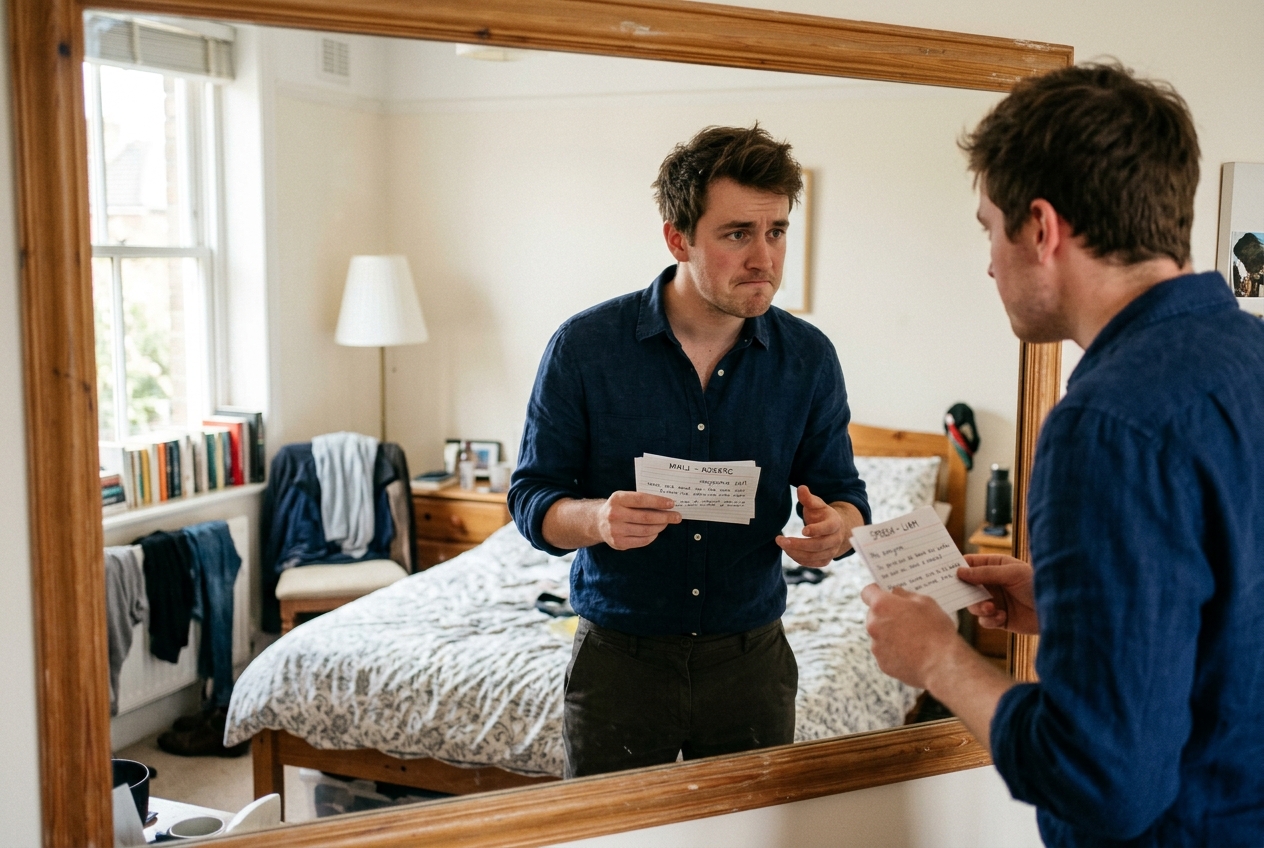
Practice schedule:
- 2 weeks before: Read the full script aloud 3 times. Time it.
- 1 week before: Practice from cue cards. Time it.
- 3 days before: Practice in front of someone (partner, friend, parent). Get feedback.
- Day before: One final run-through from cue cards. Don’t change anything.
- On the day: Read through the cue cards once in the morning. Then put them in your pocket and enjoy the wedding.
What to check during practice:
- Does it hit 5-7 minutes?
- Do the stories make sense without context?
- Does the emotional turn feel natural?
- Do you know the opening and closing by heart?
- Are there any tongue-twisters or awkward phrases?
Timing guide
| Speech Length | Words (approx.) | Feels Like |
|---|---|---|
| 3 minutes | 400-450 | Brief and punchy — good for surprise or supplementary speeches |
| 5 minutes | 650-750 | The sweet spot for most speakers |
| 7 minutes | 900-1,050 | Full-length — only if every minute earns its place |
| 10 minutes | 1,300-1,500 | Too long for anyone except an exceptional speaker |
Delivery tips
- Stand up. Always stand, even if others sat.
- Put your drink down. Hold the cue cards in one hand, not cards and a glass.
- Breathe before speaking. One slow breath. It settles your voice.
- Look at people, not the cards. Glance at the card, then look up and deliver.
- Pause after funny lines. Give the audience time to laugh.
- Slow down for sincere parts. Emotion speeds you up. Fight it.
- End strong. The toast should be clear, confident, and rehearsed.
Speech-specific guides
For detailed examples and tips for each speaker:
- Father of the Bride Speech — first in the traditional order
- Groom Speech Examples — thank-yous and emotions
- Best Man Speech Examples — funny and personal
- Maid of Honour Speech — the rising star of wedding speeches
- Mother of the Bride Speech — emotional powerhouse
- Bride Speech Examples — modern and confident
- Funny Wedding Speech Ideas — comedy techniques
- Short Wedding Speech Examples — under 3 minutes
- Wedding Toast Etiquette — who speaks when
Frequently asked questions
How do you start writing a wedding speech?
Start by listing 5-10 specific memories, stories, or moments involving the person you're speaking about. Pick the 2-3 strongest. Build the speech around those stories, adding an opening, transitions, a sincere section, and a toast. Don't start with 'Dear everyone, I'm honoured to be here' — start with the stories and add the opening last.
How many words is a 5-minute wedding speech?
A 5-minute speech is approximately 650-750 words when spoken at a natural pace. People speak at roughly 130-150 words per minute. Nervous speakers go faster (up to 170 wpm), so if your speech is 700 words at home it might be 4 minutes on the day. Always time yourself reading aloud.
Should I memorise my wedding speech?
No. Memorising creates pressure to perform, and if you forget a line, you freeze. Instead, know your speech well enough to deliver it from bullet-point cue cards. You should know the opening line by heart (confidence), the closing toast by heart (strong finish), and the rest from prompts.
What makes a wedding speech bad?
Too long (over 8 minutes), too generic (no specific stories), too many inside jokes, mentioning exes, reading word-for-word from a script, being drunk, and trying to be someone you're not. The worst speeches are long, impersonal, and clearly downloaded from the internet.