Father of the Bride Speech: Examples & Tips
Key Takeaways
- The father of the bride traditionally speaks first — setting the tone for all speeches that follow
- Aim for 5-7 minutes (around 700-1,000 words spoken aloud)
- The winning formula: a memory from her childhood, what she means to you, welcoming the partner, a toast
- Write it in your own voice — the audience wants to hear from you, not a scripted performance
- Practice out loud at least 5 times before the day, but don't memorise it word-for-word
The father of the bride speech is the most anticipated — and most feared — moment for dads at UK weddings. You’re expected to be funny but not a comedian, emotional but not sobbing, and brief but not dismissive.
The good news: the bar is lower than you think. Your audience wants sincerity, not a stand-up routine. A few honest words about your daughter, a warm welcome to her partner, and a heartfelt toast will land better than any rehearsed performance.
The traditional structure
The father of the bride typically speaks first, before the groom and best man. Here’s the proven structure:
1. Welcome and thanks (30 seconds)
Welcome guests to the wedding. Thank them for coming — especially anyone who’s travelled a long distance. Thank the couple for the invitation to speak (a touch of humility).
“Good afternoon, everyone. For those who don’t know me, I’m [name], [bride]‘s father — although she stopped listening to me around 2003. Thank you all for being here today, some of you have travelled a long way to be with us, and it means the world to [bride] and [groom] — and to [wife] and me.”
2. A memory of your daughter (1-2 minutes)
This is the heart of the speech. Share one or two specific memories that show her character — not a biography from birth to now. Pick moments that reveal who she is.
Good: A specific, vivid memory with detail. “When she was seven, she decided to open a restaurant in the garden shed. She wrote a menu, set up a table, and charged us £2 each for beans on toast. The beans were cold. She gave us no choice of main. I should have known then that she’d end up with someone who can actually cook.”
Avoid: Generic childhood timeline (“she was always a happy baby, then she went to school, then she went to university…”). It’s boring and every father says it.
3. What she means to you (1 minute)
This is the emotional peak. One or two sentences about what your daughter means to you. Don’t try to be funny here — be honest.
“I won’t pretend I wasn’t dreading this day — not because I’m not happy, but because watching your daughter walk down that aisle reminds you that the little girl who used to ask you to carry her has become a woman who doesn’t need carrying anymore. And that’s exactly as it should be.”
4. Welcoming the partner (1 minute)
Welcome your new son-in-law or daughter-in-law into the family. Be genuine. If you genuinely like them, say why. If you’re still getting to know them, focus on what your daughter sees in them.
“[Groom], when [bride] first brought you home, you did two things that told me everything I needed to know. You helped clear the table without being asked, and you laughed at my terrible jokes. You’ve been part of this family ever since.”
5. Advice or a wish (30 seconds)
A brief piece of wisdom or a wish for their future. Keep it genuine — don’t Google “wedding speech quotes” and paste one in.
“My only advice — and I’ve had 30 years of marriage to test this — is that the person who makes the tea controls the relationship. [Bride], you’ve been warned.”
6. The toast (15 seconds)
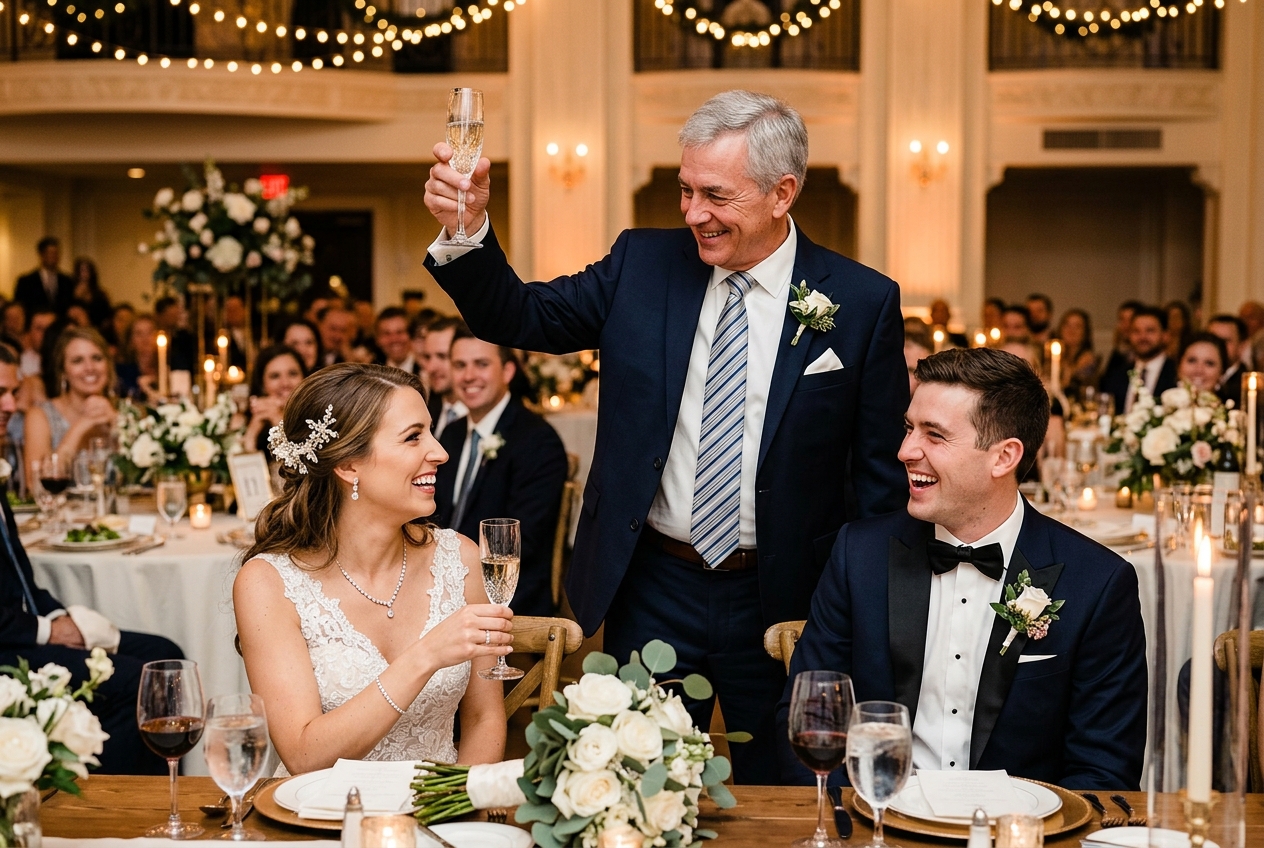
End with a clear, confident toast. Stand, raise your glass, and ask the room to join you.
“Ladies and gentlemen, please stand and raise your glasses. To [bride] and [groom] — may your lives together be filled with laughter, kindness, and cold beans on toast. To the bride and groom.”
Three example speeches
Example 1: Warm and traditional (5 minutes)
“Good afternoon, everyone. I’m David, Emma’s father. Thank you all for being here today — and thank you to those of you who’ve come a long way. Auntie Margaret, you’ve been telling me for years that this day would make you cry. I can see you’ve already started, and I haven’t even said anything moving yet.
When Emma was about six, she decided she was going to be a vet, a teacher, and a pop star — simultaneously. I remember explaining that these careers might be hard to combine, and she looked at me very seriously and said, “I’ll do Mondays, Wednesdays, and Fridays.” That confidence has never left her.
She’s grown into someone who makes every room warmer when she walks in. She’s kind without being soft. She’s organised without being bossy — well, mostly. And she still thinks she can do three things at once, which is probably why she ended up running a marketing team.
Tom, you’ve been part of this family for four years now, and I want to say something I don’t say often enough: thank you. Thank you for making our daughter so happy. We noticed the difference the moment she met you — she laughed more. And the real sign that you were right for her? The dog liked you. That dog doesn’t like anyone.
I’ve been married to Emma’s mum for 32 years, so I have some authority on this subject. Marriage is simple: be kind when it’s easy, be patient when it’s not, and never go to bed angry. Unless it’s really late. Then go to bed.
Please raise your glasses. To Emma and Tom — may your life together be everything you deserve. To the bride and groom.”
Example 2: Funny and personal (6 minutes)
“For those of you who don’t know me, I’m Rachel’s dad. For those who do know me, I’m sorry — you know what you’re in for.
I was told the father of the bride speech should be short. I was also told it should be funny. I was not told I had to achieve both at the same time, so let’s see how this goes.
Rachel has always had very specific standards. When she was nine, she sent back a sandwich at a café because ‘the butter distribution was uneven.’ I thought this was ridiculous at the time. I now accept she was right. The butter was terrible.
This attention to detail is how she planned this wedding. Every napkin has been considered. Every flower has been vetted. The seating plan went through more revisions than a peace treaty. If you’re sitting next to someone you like, that was Rachel. If you’re not, that was also Rachel. She knows what she’s doing.
James, when Rachel told us she was bringing someone home to meet us, her mother asked what he was like. Rachel said — and I quote — ‘He’s kind, he’s funny, and he doesn’t leave the cupboard doors open.’ Reader, she married him.
In all seriousness, James, you are exactly the person we hoped she’d find. Someone who sees her properly. Someone who matches her energy. Someone who will sit through three hours of a reality show without complaint, because that’s what love looks like at 9pm on a Tuesday.
Please stand and raise your glasses. To Rachel and James — may your cupboard doors always be closed, and your hearts always be open. The bride and groom.”
Example 3: Short and sincere (3 minutes)
“I’ll keep this brief, because the person I want to talk about has always been better with actions than words — and so have I.
Sophie, you are the best thing I’ve ever been part of. Watching you grow up has been the privilege of my life. And watching you marry Luke today is something I’ll carry with me forever.
Luke, welcome to the family. You make our daughter happy, and that makes you one of us.
Please raise your glasses — to Sophie and Luke.”
What NOT to say
Don’t mention exes. Not even as a joke. Not even obliquely.
Don’t embarrass your daughter. Childhood stories are fine. Teenage embarrassments are risky. Anything that makes her cringe rather than laugh has gone too far.
Don’t make it about you. This is about your daughter and her partner. Your memories of her are the vehicle, not the destination.
Don’t use Google quotes. “Marriage is not about finding a person you can live with, it’s about finding a person you can’t live without” — every wedding guest has heard this. Use your own words.
Don’t drink too much beforehand. Dutch courage becomes sloppy delivery after 3 glasses. Have one drink to settle your nerves. No more until after you’ve spoken.
Don’t read it word-for-word. Write a full script for practice, then reduce it to cue cards with bullet points. Eye contact is what makes a speech land.
How to handle nerves
Most fathers find this the most nerve-wracking part of the wedding. Here’s what helps:
- Practice out loud. Read the speech aloud at least 5 times. To yourself, to your partner, to the dog. The words need to feel natural in your mouth.
- Use cue cards, not a full script. 5-6 cards with bullet points per section. If you lose your place, the bullet point gets you back on track.
- Have water nearby. A dry mouth makes nerves worse. Sip before you start.
- Breathe. One slow breath before your first word. It slows your heart rate and steadies your voice.
- Look at friendly faces. Find 3-4 people in the room who smile at you, and rotate your eye contact between them.
- Accept imperfection. If you stumble, pause, smile, and carry on. Nobody expects a polished performance. They expect a father who loves his daughter.
Further reading
- How to Write a Wedding Speech — step-by-step guide for all speakers
- Wedding Toast Etiquette — speech order and traditions
- Best Man Speech Examples — the next speech in the running order
- Wedding Day Timeline — when speeches happen
Frequently asked questions
How long should a father of the bride speech be?
5-7 minutes is ideal, which is about 700-1,000 words when spoken aloud. Under 4 minutes feels rushed. Over 8 minutes risks losing the audience. Time yourself reading it aloud at a natural pace — people speak faster when nervous, so if it's 5 minutes at home it'll be 4 on the day.
What should the father of the bride say in his speech?
Welcome guests and thank them for coming. Share a personal memory of your daughter growing up. Say what she means to you. Welcome her partner into the family. Offer a piece of advice or a wish for their future. Raise a toast to the couple. Keep it personal, warm, and honest.
Does the father of the bride have to give a speech?
No. It's traditional but not compulsory. If the father is unable or unwilling, a stepfather, mother, uncle, brother, or close family friend can speak instead. Some couples skip the father of the bride speech entirely and go straight to the groom. Do whatever feels right for your family.
How do I calm my nerves before the speech?
Practice out loud at least 5 times in the week before. Use cue cards (not a full script — you'll read it like a robot). Have a glass of water nearby. Take a slow breath before starting. Remember: the audience is on your side. They want you to do well. Nobody expects perfection — they want sincerity.